Showing posts with label roebuck. Show all posts

Wednesday, September 2, 2020

Fawning Over This Lovely, Long Legged Steiff Prewar Rarity!

Isn't she lovely? Although all Steiff creatures are made with TLC and an eye towards appeal and realism, some also have that "X" factor - there's just something simply elegant about them. Such is the case with this lovely prewar field and forest friend. Check out this fantastic fawn and see what makes her so delightful from the design and product evolution perspectives.

There's no doubt you'll be fawning over this lovely, long legged rarity!
Here we have Steiff's 17 cm fawn. She is standing and unjointed. Her body is made from tan mohair, while her legs from the thighs down are made from tan velvet. This has darkened a bit over time, which often is the case with older velvet fabric. Her face is detailed with expressive black button eyes and a black hand embroidered nose and mouth. She has a touch of red to indicate her lips as well. Her ears are pert and triangular shaped. Her legs are especially graceful and angular. and have a touch of black airbrushing to indicate her feet. Fawn was made in 17 and 22 cm from 1934 through 1943 overall. She has a charming and distinctively old fashioned look to her. Although her Steiff button has been lost to time, she would have left the factory with either a long or short trailing "f" style Knopf, depending on her specific year of manufacture.

This velvet legged fawn design was introduced at a very turbulent time in history. Due to evolving geopolitical and financial realities, it goes without saying that things were not so good in Germany from the 1930s through the end of World War II. This impacted Steiff in countless ways and the company had to be extremely strategic in the ways it conducted its business just to stay afloat.  

One thing that collectors can track pretty closely is the company's use of different fabrics during that time.
In the mid-1930s, Steiff introduced this mohair female fawn with velvet legs, as well as a 35 cm mohair male roebuck with velvet legs. He only appeared in the line from 1936-1938. Both are pictured here on the left, hanging out with the wonderful felt doll Snik the gnome. The image is from the company's 1938 product catalog. Using a German marks to US dollar converter, and then an inflation calculator, it is interesting to note that the roebuck would cost the equivalent of about $40.61, the 17 cm fawn would cost the equivalent of about $22.97, and the 22 cm fawn would cost the equivalent of about $28.12 in 2020.  

It is Steiffgal's best guess that the pair's debut and design were carefully planned and took into consideration unreliable supply chain issues as well as economics. Given the scarcity and price of mohair during this time, Steiffgal suspects that velvet was used on the legs instead of mohair in both designs in part as a cost and material saving effort. Fortunately, from the aesthetic perspective, velvet does help give the deer's legs a very shapely and elegant presentation. 

Given how "deerly" beloved its prewar fawn pattern was, Steiff began producing it again once the factory reopened for toy making business in the late 1940s.
The basic design was tweaked just a bit and was made in 17 and 22 cm, first in artificial silk plush in 1948-1949 and then in wool plush from 1949-1953. In 1954, Steiff completely updated its fawn pattern, producing it mohair in 14, 17, and 22 cm through 1978 overall. Like their earlier relatives, these charming, more modern looking deer also had black eyes, but were now chunkier and overall less shapely, and were decorated with a little white stitch across their nose. You can see the 14 cm version of the updated post war designed fawn here on the left. 

Steiffgal hopes this discussion on this prewar mohair and velvet deer has made a material difference in your day today!

Have a question about one of your Steiff treasures? Let's talk! Click here to learn more. 

Sunday, December 17, 2017

This Late 1920's-Era Deer Is A "Reh" Of Sunshine Indeed!

Oh deer! What do we have here? Steiffgal recently had the pleasure of handling a lovely vintage Steiff fawn with the most charming expression and presentation. Check out this fantastic field and forest friend and see what makes her so interesting from the historical and product design evolution perspectives.


This "reh" (German for deer!) of sunshine is Steiff's "Deer." She measures about 28 cm both standing and wide. Deer is unjointed and made from burnt-orange tipped mohair. The insides of her ears and her fanny are made from white mohair. Her hooves are indicated by black airbrushing. Reh's face comes to life with oversized black and brown pupil eyes, a distinctively shaped, hand embroidered nose highlighted with a white stitch, and a tiny red accent to indicate her mouth. She retains her long trailing "F" button and traces of her red ear tag as her Steiff IDs.

So just how old is this darling deer? It is interesting to note that this exact model is not noted in either the Steiff Sortiment reference book or Steiff's catalogs. But, because it is impolite to ask anyone directly about their age, Steiffgal's detective work suggests that she was made in the 1929-1934 time frame. An almost identical deer, albeit on red wooden wheels, is noted in Steiff's records. This model was produced in 28, 35, 43, and 50 cm from 1929 through 1936. Because the model under discussion today has bits of her red ear tag, which was the eartag color through about 1934, this deer is probably no older than 1934. You can see the wheeled version here on the left; the image is from Pfeiffer's 1892-1943 Steiff Sortiment.
This deer has two key design details that place her at a very interesting place in the deer product development timeline.

Materials. You can't help but notice this deer's wonderful and colorful fabric - a burnt orange tipped mohair. They "heyday" for tipped mohair at Steiff occurred during the mid to late 1920's through the early 1930's. Other well known famous patterns from that era that used this distinctive, playful, and happy fabric included Petsy the Baby Bear (1928 through 1930); Teddy Clown (1926 through 1930); and Fluffy the Cat (1926 through 1943.) Very few items were with tipped mohair were introduced in the line after the 1930's.

Form. This wide-eyed and youthful deer's appearance aligns perfectly with the mid- to late 1920's Steiff aesthetic. Items produced during this time frame were for the most part utterly charming, with a distinctively toddler-esque, feminine, and happy appearance. In the mid-1930's, Steiff updated some of its fawn and roebuck pattens. These new designs were made from tan, airbrushed, mohair; had more shapely legs and bodies; and more realistic and lifelife necks and faces. In addition, their legs were made from velvet instead of mohair. There are several possible reasons for this fabric change. One might be that during the mid- to late 1930's, mohair was becoming more expensive and less available due to political and economic realities. Steiff's mid-1930's-1943 fawn with velvet legs is pictured here on the left; the image is from Pfeiffer's 1892-1943 Steiff Sortiment.

Steiffgal hopes that this discussion on this unusual and appealing Steiff deer has you fawning over Steiff's great late 1920's era items.

Have a question about one of your Steiff treasures? Let's talk! Click here to learn more.

Saturday, June 27, 2015

It's Steiff Christmas In July - Well, Almost!

It's Christmas in July! Well, almost! The magic of Steiff certainly lasts all year, with unexpected "gifts" like this sometimes showing up in the most delightful ways. Check out this note from a new friend who writes about a very special heirloom that has been in her family for over six decades. Through a series of correspondences, she shares....
 

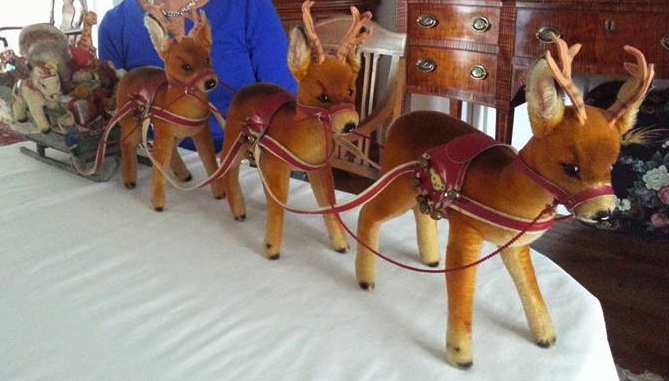
"For 60+ years, this Santa miraculously appeared in the center of the dining room table during every Christmas Eve. Although, as a little girl, I paid particular attention to the goings on, Santa always arrived unannounced as if by magic. By Christmas morning he would be gone, leaving a child’s presents behind. It was the same for my children, and hopefully it will be for theirs. 

I have tried to find out more about my Christmas friends, but cannot seem to find a reference other than the Steiff’s Santa himself. There are smaller sleighs, but clearly, this one, with is bridles and sleigh attachments was something quite unusual. The small presents are all wrapped and appear “attached” to the display.
I believe my parents purchased this centerpiece in Germany in the 1950's. We lived in several cities in Germany when I was growing up. I think my mother once suggested that it was in the Steiff shop window as a display piece for Christmas. I think she had to wait until after Christmas to purchase it and then waited the full year to place it in our world.

Might you know more? I would appreciate all that you can tell me about these 60 year old friends. Thank you so very much.

What a wonderful item, with such great family history.  Let's first take a look at the two core Steiff items in the piece - the Santa doll and his reindeer.  

Santa clearly rules the reins here!  This sweet doll is clearly Steiff's earliest post WWII Santa doll. An example is shown here on the left. He is s 31 cm and five ways jointed. Santa has a rubber head; felt body; bright red felt suit, boots, and cap trimmed in white wool plush; and a white fluffy mohair beard.   He is self standing and has an amazing resemblance to the jolly man from the north pole!  From the collector's perspective, it is interesting to note that Santa's head was created from the same molds and patterns used for Steiff's three lucky dwarfs, Gucki, Lucki, and Pucki.  Santa was produced in 13, 18, and 31 cm from 1953 through 1963. 

It's time to buck the trend and check out Santa's dear deer.  The display features three Steiff's Rehbock or Roebuck. An example of this pattern is shown here on the left. They are each an impressive 35 cm tall, unjointed, and made from tan mohair. They are beautifully airbrushed with golden brown highlights, making them truly handsome beasts. Each also has highlight detailing on his legs, body, and face. All have ears are lined in mohair, white mohair tails, and fabulous felt antlers.  Their faces all come to life with black button eyes, a black hand embroidered nose and mouth, and a red accent on their snouts.  This pattern was made from 1954 through 1974 in this size only. 

So what does this all mean in terms of dating the display?  It is Steiffgal's best educated guess, given the configuration of the items pictured and the timeline suggested by the owner, that this was put together around 1954.  This the earliest date that both the rubber faced Santa and the large mohair roebucks both appeared in the line.  It goes without saying that this is a very attractive showpiece - that is made from relatively standard line toys from the early to mid-1950's.

The sled, decorated and branded harnesses, fittings, and wrapped gifts do look to be Steiff quality and were not produced on a commercial scale.  You can see a close up of some of these accessories here on the left.  Again, it is Steiffgal's feeling that this display was originally designed by Steiff in Giengen as a special request window display or focal point for a toy, department, or other high end store in Germany.  And, given its period of production, as well as craftsmanship, is possible that it was part of a larger animated window display as well.  
 
A few things in the display were not made by Steiff, including some clip-on koala bears, but they were most added on in a loving fashion over the years to enhance the presentation (most likely from a youngster's point of view.)  It is not clear if some other Steiff items in or on the sled, including a small velvet giraffe, mohair pony, and a small gnome or two, are original to the display or like the clip on koalas, were added in at some point. 

It is Steiffgal's understanding that it was not out of the question for stores to sell these elaborate holiday display items post season to special customers.  These were not in general available to the public.  Or, perhaps it is possible that the current owner had family or a family friend with connections to a store or even a Steiff executive who was able to procure this for her family.

Steiffgal hopes this discussion on this wonderful Christmas family heirloom has put you in a most festive state of mind.
 
Have a question about one of your Steiff treasures? Let's talk! Click here to learn more. 

Sunday, April 26, 2015

Fawning All Over This Delightful and Very Early Steiff Deer On Wheels

Steiffgal loves to "field" questions from all over the world. So this wonderful inquiry from Canada about a very vintage field and forest friend really caught her eye. Check out this note from Kendra, who shares through a series of correspondences...
 

"Hi Steiffgal,

I have a Steiff deer that stands approximately 18-½ high at the head and is 18-½” long from the nose to the tail. The closest I can come to describing the material would be a felt-like texture. The eyes are solid black. It appears to have had a red mouth at one time. The diameter of the button in ear is 5mm. This item was purchased at an estate auction several years ago.  Is there anything that you can tell me about this piece?

Thank you, Kendra"


Oh deer, where to start with this lovely creation?  What we have here is Steiff's early deer on wheels.  He is standing, unjointed, and riding upon a metal carriage with four metal wheels.  His handsome head and face are detailed with felt lined ears, great felt horns, and black button eyes.  Based on a close up study of his actual material, Steiffgal believes he might be made from what's called "simple plush," a very early material Steiff used on "furry" animals at the turn of last century.  It is possible that he left the factory in Giengen wearing a simple collar with a bell.  This pattern was produced in 22, 28, 35, 43, 50, and 60 cm from 1899 through 1919 overall.  

Given that models with horns were only produced through 1908, and that the deer has a tiny trailing "f" button, it can be determined that Kendra's deer on wheels - which is either the 43 or 50 cm version -  was most likely manufactured in the 1906 to 1908 time frame.

It's easy to get the warm fuzzies looking at this wonderful deer!  And his materials are truly reflective of the transitional era of his manufacture.  Mohair became viable on a commercial scale in Germany around 1903.  It turned out to be a great material for Steiff's newly introduced Teddy bears, as well as other naturally "furry" animals in the line.  However, before 1903, Steiff was producing fuzzy products including dogs, cats, bears, and field and forest animals like deer.  In order to give these earliest turn of last century items as much of a realistic touch as possible, they were made from period toy making fabrics, including early textured plush materials like this "simple plush" and short pile plush. As time went on, Steiff started transitioning their designs from these early fabrics to mohair, which could be produced in almost infinite options in terms of color and texture.  It also offered a soft, lush, authentic appearance, which perfectly aligned with Steiff's position as a growing worldwide leader in the international toy marketplace.  

Steiffgal hopes you have fawned all over this discussion on Kendra's vintage deer!

Have a question about one of your Steiff treasures? Let's talk! Click here to learn more.
The teddy bear search engine