Anyone care to go on a little time travel adventure? Steiffgal just purchased a wonderful Christmas catalog from F.A.O. Schwarz from 1932. Flipping through it is better than a front row seat in a program about the history of this great toy store! One of the things that is so interesting about this catalog is how many Steiff items are featured within its pages - and on its cover! Let's have a look inside and see how people in the United States were celebrating with Steiff 85 years ago.

Steiff starts out in the pole position in this great catalog, being featured exclusively on the back cover! Pictured friends include Steiff's kangaroo, Mickey Mouse, white Jocko monkey, Teddy Baby bear, and Fluffy Cat, all playing around a giant red mohair play ball. It is interesting to note, as far as Steiffgal can tell, that the kangaroo and Mickey are the only items that are specifically listed for sale; there is no mention of the white Jocko, Teddy baby, Fluffy cat, and ball within this catalog's pages. This is somewhat unusual given their prime positioning on this key sales document, and all four unmentioned items were clearly in production at the time of the publication. Nonetheless, as the photo's banner proclaims, Steiff proves that "It's fun to shop at SCHWARZ."
 So, first things first. Steiff indeed is noted on the front inside cover (which is not numbered) of this catalog. In the upper left hand corner of the page is Steiff's "Wooly Lamb." It is described as, "Everywhere the children go this lamb is sure to go along. It's adorably appealing with its woolly white coat, closely resembles lambs wool, realistically touched here and there with natural tints. Flexible ears and a squeaky voice. Bell on neck ribbon. Measures 8" high. $2.00." $2 in 1932 had the same buying power as $33.07 in 2017. This item appears to be Steiff's standing, unjointed Lamm or Lamb, which was produced in 14, 17, 22, and 28 cm from 1928-1936 overall.
 Page 1 features two and maybe even three Steiff goodies. The first two are Steiff hand puppets - one labeled "Hand Monkey" and the other "Hand Mickey." Hand Monkey is clearly a Jocko puppet, and is described as, "An amusing toy, realistically animated by the movement of the fingers. Superior make, fine brown plush. 9-1/2", $1.00." Hand Jocko appeared in the line from 1911-1943 overall. Hand Mickey is a Steiff Mickey Mouse puppet, and is described as, "Just slip Mickey over your hand and he will perform for you as you wish. Black and white plush, $1.00." Hand Mickey appeared in the line from 1931-1933. In both cases, $1 in 1932 had the same buying power as $16.54 in 2017.
The third item is probably partially Steiff, and most likely put together in house at F.A.O. Schwarz. It is a "Monkey With Organ," and it is described as, "An appealing little fellow, sitting on a wooden organ box. Organ plays two different tunes when you turn the crank. Strap to hang around neck. Very appropriate to these times. $6.00." This looks to be a standard line 22 or 25 cm brown Steiff Jocko on a lovely, high quality European music box. F.A.O. Schwarz was well known for creating these sorts of special editions by combining a few top tier items into one really special, usually very expensive one. And this fits the bill here: $6 in 1932 had the same buying power as $99.22 in 2017. Steiff's standard line, fully jointed brown mohair Jocko monkey appeared in the line from 1909-1943 overall.
 Things are on a (Steiff) roll on page 2 of this catalog, with a pair of Steiff record style pull toys. The first is "Mickey on Coaster." It is described as, "A beloved friend in a different role. Mickey, all velvet covered, rides merrily on his own coaster when pulled about by the cord. 8-1/2"." This is clearly Steiff's Record Mickey, who appeared in the line from 1931-1933. The second is "Monkey Peter." It is described as, "Peter, made of gay red felt, sits expectantly upon a coaster. When you draw it by the cord, he makes a comical movement and sound with his voice. Height 9-1/2." This selection is a red felt version of Steiff's Record Peter, which appeared in the line in 20 and 25 cm from 1913-1938. Both were priced at $2.50; $2.50 in 1932 had the same buying power as $41.34 in 2017.
Page 6 of this catalog really goes to the dogs, with many popular breeds listed. These include Sealyhams, Pekingese, Fox Terriers, and Scotch Terriers. It is impossible to tell with 110% certainty if these models were indeed made by Steiff, as the black and white photos are small and don't reveal many details, and the descriptions are somewhat generic. However, all of these dog breeds were in the Steiff line at the time, so it is probable that at least a few of these were indeed whelped in Giengen.
 Page 7 offers up several familiar and beloved Steiff friends, with Teddy bears playing a prominent roll. These cubs are described as, "A faithful friend and just as loveable as ever. Jolly jointed Teddy Bear of fine plush in cinnamon or white." They were advertised in seven sizes ranging from 10" to 20", and were priced from $1.50 to $7.50; this equals $24.80 to $124.02 in 2017 dollars.
A "Kangaroo With Its Youngster" makes a bouncing appearance here. She is described as, "This gentle mother Kangaroo of silky plush has a voice and moves her head. The little one can be used as a separate toy." The pair were offered in 14" for $4.75 or 19" for $7.50; this equals $78.55 and $124.02 in 2017 dollars. This head jointed model was Steiff's Kangaroo, which was produced in 10, 35, 43, and 50 cm from 1929-1939 overall.
"Mickey and Minnie Mouse" again rule the house. These charming dolls are described as, "Here is the gay and loveable Mickey and Minnie (new), in various sizes, all soft stuffed and covered with high quality velour." Five sizes of each, ranging from 7 to 19 inches, were noted, with prices spanning $1.00 to $5.00. This translates into $16.54 to $82.68 in 2017 dollars. These of course are the Steiff models, produced from 1931 to 1936 overall.
And tucked into the bottom right hand page is a dear "Pony." This handsome horse is described as, "A soft stuffed animal for small boys. In brown and white plush, with flowing mane and tail." It was available in 8" for $3.50 and 10-1/2" for $4.75. This translates into $57.88 and $78.55 in 2017 dollars. Given its appearance and size, it is Steiffgal's best guess that this pony is Steiff's standing, unjointed white and brown Pony, produced from 1931-1939 overall in 17, 22, and 28 cm.
 Finally, this catalog proves that good things come to those who wait - and sometimes in small packages, too. Under the category of "Unusual Stocking Toys," at the end of the document, the following is listed: "Pair of Wooly Birds." They are simply described as, "on 4-1/2" voice bellow platform. $0.75." This pair is most certainly Steiff's rare and unusual "Chirp Couple," consisting of two metal legged woolen miniature birds on a see-sawing whistle platform. This piece was in the line from 1932-1943 and is very, very rare today, given the ephemeral nature of its construction. Its price, which translates to $12.40 today, seems unbelievable, given that the Auctioneer Teddy Dorado sold one for 1,600 euro in 2014!
Steiffgal hopes that you have enjoyed this historical - and virtual - Steiff shopping spree!
Have a question about one of your Steiff treasures? Let's talk! Click here to learn more.


 Posts
Posts


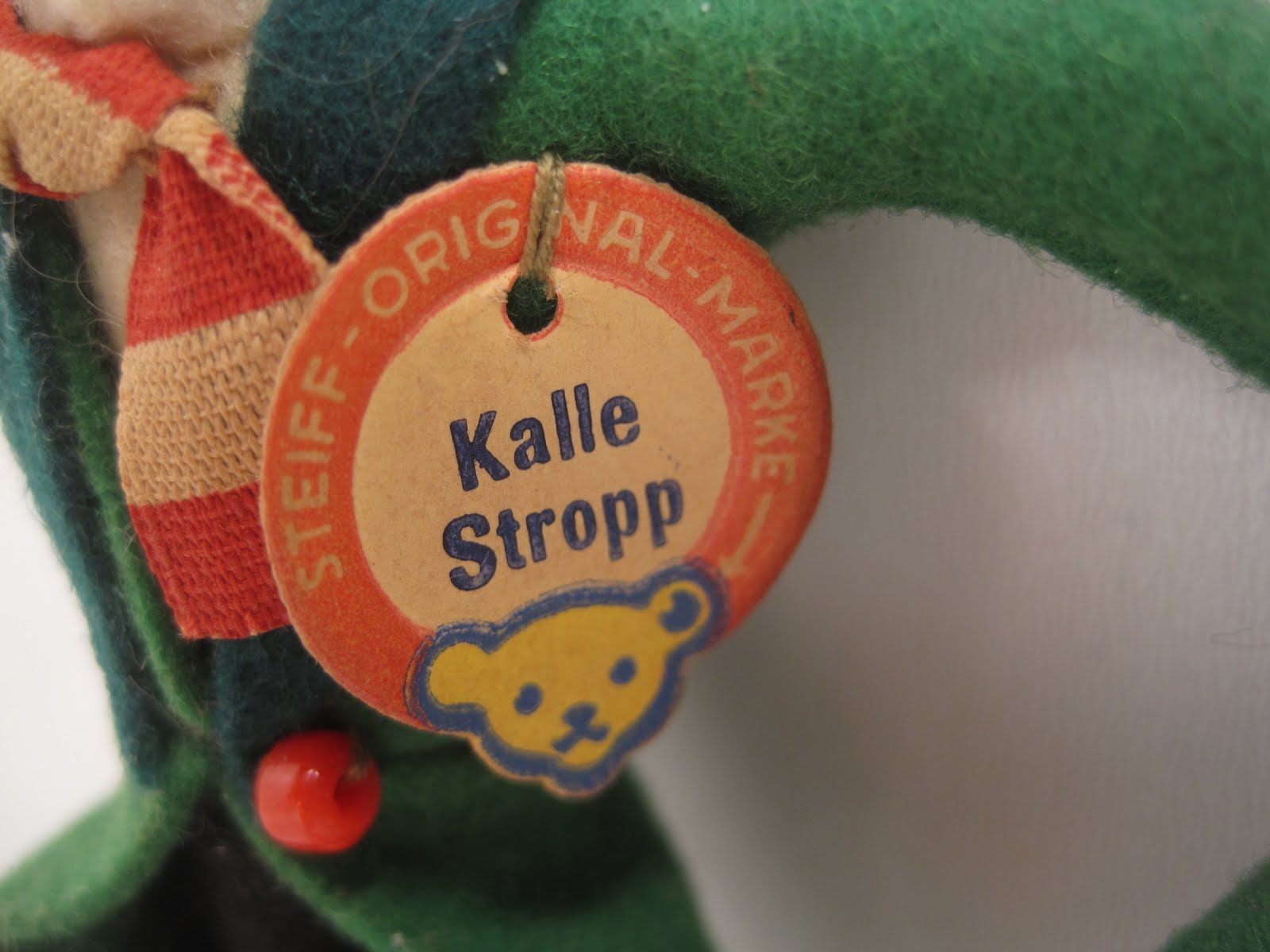
 This happy hopper is Grashuepfer (grasshopper) Kalle Stropp. He is 18 cm tall and head jointed. Let's start at the top by describing his head. It is constructed from green velvet and is decorated with black painted nostrils, a smiling mouth, and antennae made from clear plastic rods that are topped with two round, red balls. His eyes deserve special mention for their detailing. They are made from tiny black buttons and backed in white material, somewhat like the eye treatment on the company's Bambi. They are highlighted with painted pink shadows and black eyebrows. Interestingly, Kalle has a black floss loop of thread sewn into the back of his long, thin neck. It appears to be original to him; perhaps it was put there so he could hang from a hook or a car's rear view mirror. Steiff made a number of these "hanging style" mascots in the 1950's.
 Now let's check out the rest of him. His body is made from heavy metal wire that feels somewhat like the wire used on the feet and legs of the company's woolen miniature birds of the same period. His five fingered hands are made from light green felt. He is wearing a white felt collared shirt, red and white striped fabric bow tie, black felt pants, and a light green felt cutaway style topcoat. His jacket is detailed with darker green lapels, white felt cuffs, and seven red bead buttons - two on each sleeve, two in the rear, and one in the front. Black felt shoes with red felt soles complete his runway-grade outfit. Kalle retains his colorful, named, bear faced chest tag and raised script button (located in the tail of his coat) as his Steiff IDs.
  The amount of work and the number of fabrics used on this big bug are simply astonishing. And given the ephemeral nature of his construction and materials, it is amazing that he is still with us today.