Sunday, September 8, 2019

Does This Steiff Story Have A Familiar Ring To It?

Now for something really different, and really fantastic. Steiff animals have always been a part of key family and life cycle events, and here's perfect proof of that. Check out this note from a reader who asks about her Grandmother's special Steiff treasure. She writes, 

"My Aunt, who is in her seventies, recently sent me this lamb that belonged to my Grandmother who was born in 1915. She claims that my Granny’s engagement ring was presented tied to its neck; this would have been in the 1930s. 

My Mom thinks it was a tradition at the time to present a ring attached to a toy or object. She also believes that Grandma's engagement followed her "pinning" at Christmas, which involved a 1930s-era Steiff miniature woolen fawn. My family sent you photos of this little fawn in 2012 and you helped us figure out that mystery a few years ago. It it possible that this this lamb carried the "next step" in Grandma's engagement engagement process? My Granny always loved little stuffed animals and dolls - she collected them later in life. Thank you!"

How fun, and where to start? If you are not familiar with the Steiff woolen miniature fawn "pinning" story mentioned above, please check out that heartwarming post here! The little guy pictured here on the left steals THAT show, and a few hearts along the way! Make sure to scroll to the very end of the story where you can see a remarkable, almost century old photo of the reader's Grandmother at Christmas time with this fantastic Steiff woollie fawn.

So now let's fast forward to the item under discussion today. What we have here is indeed a barnyard buddy, but it is a goat, not a lamb! This goat's name is Zicky. Steiff made these from 1952 through 1972 in 10, 14, 22, 28, and 35 cm. All were unjointed, standing, and made from off white mohair with felt detailing. They came to life with beautiful airbrushed highlighting, including coloration on their backs and legs, and a touch of red on their lips. Zicky goats had black and green slit pupil eyes and black, simple noses and mouths. And given their production era, all had raised script style Steiff buttons, as shown here on the left. Medium and larger sized versions sported wooden or felt horns. All examples left the factory decorated with a silken ribbon and a brass bell. 

This beloved goat pattern was also produced in 14 cm on red wooden eccentric wheels from 1953-1957 and in a somewhat rarer "lying" pattern in 10 and 14 cm from 1954 through 1956.

So, do things align here? Given that the Zicky pattern was introduced in the early 1950s, and the great exchange happened in the 1930s - it is not possible that this goat delivered Granny's ORIGINAL engagement ring, at least in the time and space continuum that Steiffgal knows of. However, it is entirely possible that this goat DID participate in another special ring exchange - perhaps for a 25th wedding anniversary or other milestone event - and the family story just got a little out of order over time.

Steiffgal hopes this great Steiff family story had a familiar ring to it!

Have a question about one of your Steiff treasures? Let's talk! Click here to learn more!

Sunday, September 1, 2019

Spicing Things Up With This Very Vintage Steiff Dachshund

You've heard the expression "age before beauty," but today's special blog guest clearly wins hands down in both categories. This delightful doggie is one of the oldest (and most handsome) canines Steiffgal has in her hug. In dog years, he's nearly 750 years old! Come see what makes him such a top dog in every way.

This precious pooch is standing and five ways (arms, legs, and head) jointed. His head, back, tail, and outer limbs are made from vibrantly hued cinnamon mohair. His chest and inner limbs are made from white mohair which has mellowed to a vanilla color over time. He has three black hand embroidered claws on each of his paws. His face and head come alive with long, floppy felt lined mohair ears, black shoe button eyes, and a black hand embroidered nose and mouth. He retains his original tiny long trailing "f" button and traces of his white ear tag. This pattern appeared in the line in 17 and 22 cm from 1911 through 1913; this is the 17 cm version. These dogs were measured vertically, from the top of their heads to their toes. 


It is so cool how his design details perfectly converge on his era of production. Four really pop here. 

The first is his color. This great cinnamon mohair color is seen once in a blue moon, and mostly on items through the 19-teens. Steiffgal has also seen this color on early bears, monkeys, and squirrels. 

The second is his jointing. Through the 19-teens, it was not unusual for Steiff to joint, or "uber-joint" its popular animals. For example, squirrels and cats were head, limb, AND tail jointed. And some rabbit models were fully jointed - plus had each of their ears jointed! This dandy Doxie is head and limb jointed, which adds to his playfulness, but also to his cost. Fully jointed dogs like this are extremely rare in the Steiff line.

The third is his eyes. This great example has black shoe button eyes, like most items produced before c. 1912 or so. Starting in the mid-teens, Steiff primarily produced their items with black glass, or black and brown glass pupil eyes, to add to their appeal, prestige, and authenticity.

And the last is his facial construction and presentation. After studying this pooch for awhile, Steiffgal noticed that his face has a center seam construction, and a shaved muzzle. These two desirable - and clearly period - design elements are most often seen on Steiff's earliest Teddy bears.


Dachshunds have always been a popular breed in the Steiff production kennel. The 1913 English catalog features eight variations of these "badger dogs." Here on the left you can see this five ways jointed example under discussion today. You can click on the photo to make it larger. He is simply noted as "jointed, fine plush, brown &white/brown." Two models are noted; one at 17 cm and one at 22 cm. And just how much is that doggie in the window? The catalog notes that the 17 cm version costs $1.40 (the equivalent of $36.28 in 2019) and the 22 cm version costs $1.90 (the equivalent of $49.24 in 2019.)

Steiffgal hopes this discussion on this darling Doxie has generated a bit of puppy love for you. 

Sunday, August 25, 2019

Care To Take Flight With This Red Woolen Miniature Bird?

We all love to feather our nests with fine Steiff treasures! Some of us prefer bears, or dolls, or the company's delightful menagerie of other animals. Check out this note from a new friend in New York who just happens to love Steiff's woolen miniature birds. He came across an unusual example and wants to learn more about it. What do you think about his fine feathered friend? He shares, 

"I have been collecting Steiff wool birds for about 10 years. I have one odd item in my collection which I hope you might be able to shed some light on. This bird was purchased online a few years ago from the original owner. Around the late 1950s, she and her siblings received Steiff wool miniatures each year at Easter, purchased at F.A.O. Schwarz. This bird was one of those she received. I have not seen any others like it. .... Do you know if this bird was a standard item, or maybe a special for F.A.O. Schwarz? Any other information you can provide would be most appreciated."

Bird's the word with this thoughtful inquiry! It is Steffgal's suspicion that this bird was not made by Steiff, but was made by another company to somewhat resemble the company's woolen miniature "exotic songbird" pattern. These pretty Steiff pets are 9 cm tall, standing, head jointed, and made from colorful woolen yarns. They come to life with a small felt beak, felt tail feathers, pert, tiny black button eyes, and plastic feet and legs. These were produced in a number of colors including yellow and white, blue and white, green and white, and red and white from 1953-1958 overall. They were also packaged as a "bird tree" on a wooden display as a standard line item from 1953-1956. You can see the bird tree and the range of exotic birds here on the left. The photos are from Pfeiffer's Sortiment book; you can click on the image to make it larger.

Birds of a feather flock together, so it is no surprise that the differences between the inquirer's bird and the standard Steiff exotic bird are pretty subtle. The Steiff exotic songbird version has three longer, narrower top feathers while the inquirer's has four rounded ones that look more like a comb. The Steiff version has seven tail feathers that are more integral to the bird; the inquirer's version also has and seven tail feathers, but they fan out more like the letter V. The Steiff version has black eyes and a small black felt beak. The inquirer's bird has red eyes and a larger scaled, dark red felt beak. The legs on both versions are similar; this is entirely possible as it is Steiffgal's understanding that Steiff did not manufacture the plastic legs but purchased them from a specialty company. As such, the plastic manufacturer could provide the same legs to multiple customers. Steiffgal suspects that the company that made this bird changed up the details and coloration a bit from Steiff's to insure that they were not infringing on Steiff's designs.

Now let's catalog a little of this bird's retail origins. Even though this bird does not appear to be made by Steiff, it is entirely possible that it was purchased at F.A.O. Schwarz. Steiffgal has a woolen miniature bird in her collection that was not made by Steiff, but also purchased at F.A.O. Schwarz. F.A.O. Schwarz had multiple suppliers providing items across categories. The inquirer also asks about the possibility of this bird being an exclusive item for F.A.O Schwarz. Even if it were made by Steiff (and it almost certainly was not), this bird is too "small" with not enough "value" to make it worth either company's time in creating an exclusive product - which took alot of effort and resources on all ends. Having worked on Steiff and F.A.O. Schwarz exclusives firsthand in the past, Steiffgal can attest to this with certainty.

Steiffgal hopes this discussion on exotic midcentury birds has been a rare treat for you.

Have a question about one of your Steiff treasures? Let's talk! Click here to learn more!

Thursday, August 15, 2019

It's Three Of A Kind With These Midcentury Steiff Panda Triplets

The devil - or the discovery - is in the details! And this is especially true when it comes to Steiff's World War II era (c. late 1930's-early 1950's) editions. Patterns that were made throughout these turbulent years often had slight design and/or material changes over time due to supply or manufacturing constraints. These differences are subtle, but extremely interesting as well. Here's one example that is pretty black and white in these regards.

Here we have three Steiff pandas. All are 12 inches tall or 30 cm, 5 ways jointed, and made from black and white mohair. They have small, somewhat triangular shaped open, peach colored felt lined mouths, brown and black pupil eyes, and black, horizontally stitched noses. The black around their eyes, as well as across their back, is airbrushed. Like Steiff's beloved Teddy baby pattern, these also have flat, cardboard lined feet made for standing and downcurved wrists.

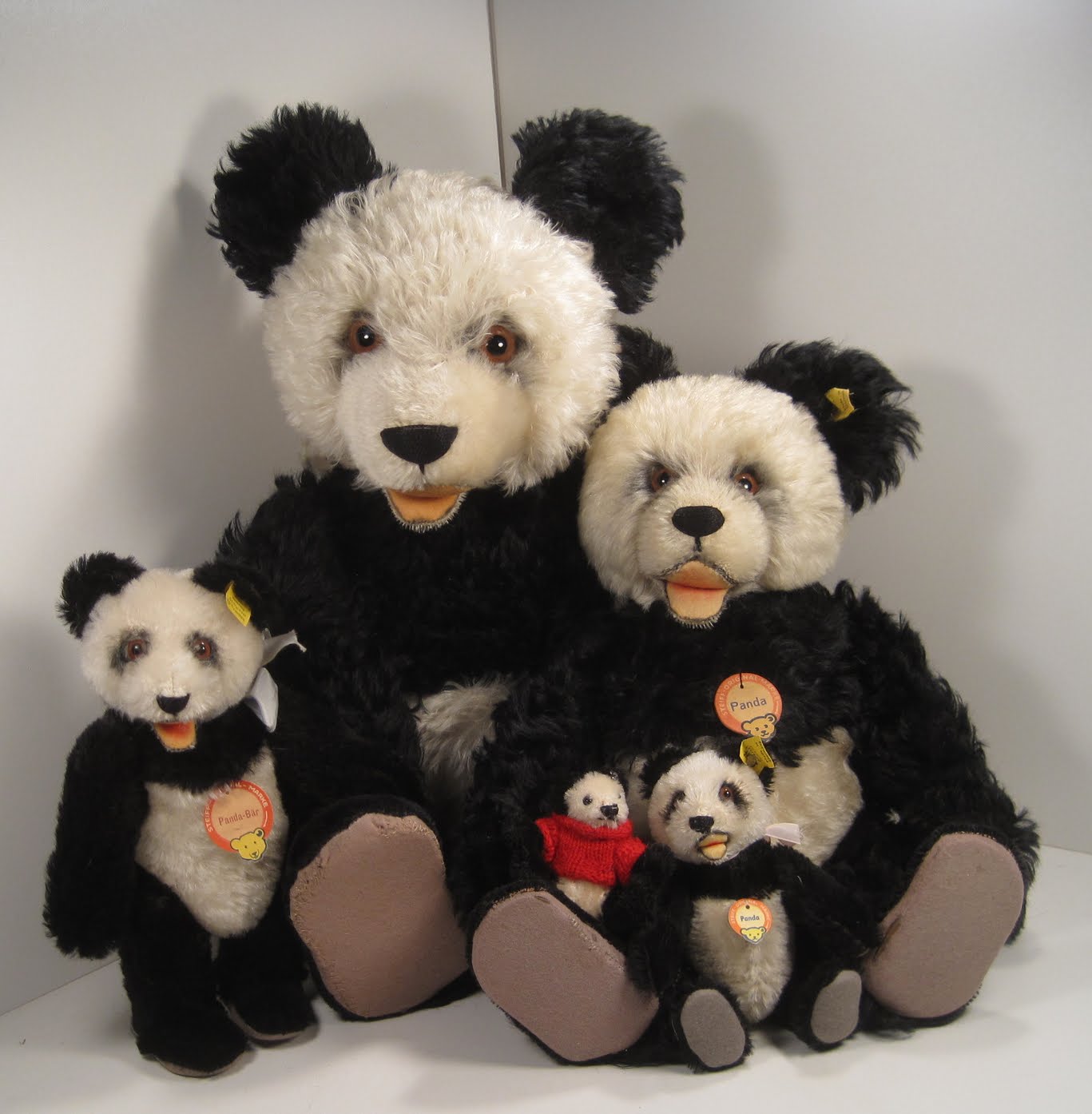
This adorable, child-like Panda design was launched in 1938, the same time Pandas made their grand debut at several zoos across the world. Prewar, this perky Panda was made in 15 and 30 cm through 1942. Postwar, this identical Panda design appeared in the line in 30 cm from 1949-1950. In 1951, Steiff updated its Panda design, producing their happy black and white cub in 15, 22, 28, 35, 43, and 50 cm from 1951 through 1961. The new model was produced in larger sizes than previously offered and had a different facial configuration, including a rounder mouth and a fuller, more sculpted muzzle. He had grey felt paw pads from 1951 through 1956 and suede-like grey rubber material paw pads from 1956 onward. The "updated" design from 1951 onward is pictured here on the left for your comparison. 

So now let's jump to some material matters when it comes to this jolly trio of early Steiff Pandas pictured at the top of this post. It's true they could be triplets, sort of. All are the companies pre-1951 pattern. But check out their paw pads and IDs - they are really quite diverse. The one on the far left has thick grey felt pads that have black fibers woven within the fabric. His ID is a raised script button. The one in the middle has linen pads and a short trailing "f" button. And the one on the right has regular grey felt pads and his raised script button and yellow ear tag as his IDs. A close up shot of the unusual grey and black felt pads, and the linen pads, are featured here; you can click on the image to enlarge it.  

So what is their birth order here? 

Hum, well, this will take some sorting out... and not all the dates and time lines align perfectly here. That's pretty standard when it comes to Steiff "mid-century mysteries." 

So, that being said... it is Steiffgal's best guess that the one with the linen pads and long trailing "f" button is the oldest, given his detailing. He might just be prewar, or immediately post war, as you see this linen treatment in items from the 1940s. Next in age - or the "middle child" - is probably the one with the thick grey felt pads and raised script button. His felt is unusual, and a little odd for Steiff production, so Steiffgal suspects Steiff used what felt was available, or on hand, to produce this pattern. And Steiffgal is pretty certain the one with the standard grey felt pads is the "youngest," relatively speaking. His pads closely match the ones used in the 1951 updated Steiff Panda pattern. The photo on the left is from a late 1930s Steiff catalog and shows Steiff's 1938-1950 Panda palling around with dolls and rabbits from the same era.

Steiffgal hopes this discussion on the company's mid-century Panda design has not left you bamboozled. 

Have a question about one of your Steiff treasures? Let's talk! Click here to learn more!
The teddy bear search engine