Showing posts with label goose. Show all posts

Monday, January 3, 2022

Taking A Joyride With This Midcentury Steiff Car Display

So let's kick off 2022 in fifth gear! It's always so much fun to learn about unusual Steiff display pieces, and this one will make you want to hit the road for sure. What secrets do its design elements hold? Check out this note and photos from Susie in Ohio. She shares, 

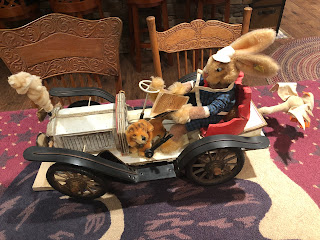
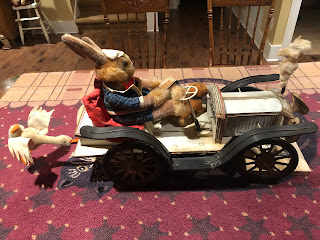
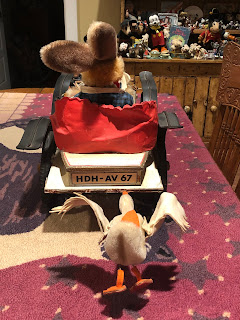
"This is a wonderful Steiff display piece I own that I call "Distracted Driving!" It has a Lulac, a Cockie, and a Tulla Goose. When you push the car, the goose wings flap up and down and the cotton smoke stack in the front rotates. It is in pretty great condition although some of it is made from rubber and has become slightly brittle. This does not distract from its irresistible charm. I honestly think this display should be in a museum somewhere!"

A joy ride indeed!
Steiff's tradition of creating still and animated displays goes back to the dawn of the 20th century. These first, early vignettes reflected things like life in a small town, farming, schoolrooms, or sports, among others. In some cases, these were photographed for advertising purposes, while in others, the scenes were actually sold as a package to stores as displays. It wouldn't be long before Steiff's creative team brought these scenes to the next level with movement; in about 1910 the company launched the large-scale, mechanized window display pieces that it would continue to produce throughout the 20th century. Albert Schlopsnies, a design and creative freelancer for the company, is responsible for many of Steiff's most breathtaking museum, retail, exhibit, and special event displays through the mid-1920s. 

Now let's take a closer look at Susie's display.
 
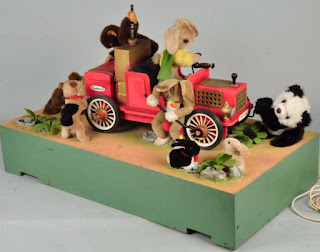
Its passengers include two standard line items and one modified standard line item. Given its form, materials, and detailing, it is Steiffgal's best guess that this display was made sometime in the c. 1955-1965 timeframe. Steiff used the "old jalopy" car concept in its automaton production frequently throughout the third quarter of the 20th century. Here on the left you can see a similarly themed display from the late 1970s or so; the photo is from LiveAuctioneers/Morphy Auctions. 

Taking the wheel of this display is Steiff's legacy Lulac rabbit.
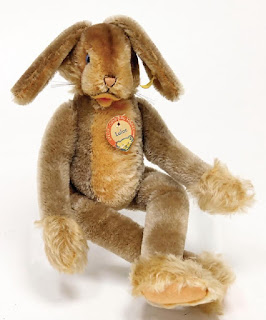
This long legged lovely was produced in 43 cm from 1952-74 and 60 cm from 1964-66. Given the scale of display, it is Steiffgal's best guess that this is the smaller version. He is five ways jointed, features comically long arms, legs, and torso, and is made from made from caramel and light orange mohair. His paws are made from longer, shaggy mohair. His face comes to life with an open, peach felt mouth, a pink embroidered nose edged in black, and blue and black googly style eyes. It is possible that his name derives from a combination of the German words associated with laughter, smiling, and a "long and lanky" presentation. You can see Lulac here on the left, the photo is from Liveauctioneers/Ladenburger Spielzeugauktion GmbH.

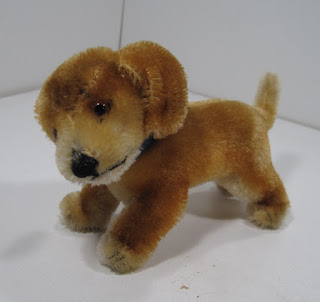
Lulac's wingman is a standing Bazi dog.
He is made from short tan colored mohair that is accentuated with darker airbrushed highlights on his back, chest, and head. Bazi's face is detailed with black and brown pupil eyes and a hand embroidered nose and mouth. Bazi left the factory in Giengen wearing a blue leather collar with a little brass bell. The standing mohair version of Bazi was produced in 10 and 14 cm from 1950 through 1975. Given the presentation of the display, it is Steiffgal's best guess that this is the 10 cm version. You can see standing Bazi here on the left, the photo is from Steiffgal's collection. 

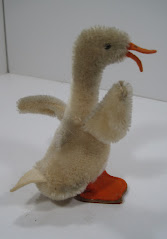
At the tail end of all of this - and yes, pun intended - looks to be a little Tulla goose, sort of. 
Regular line Tullas are standing, unjointed, and made entirely from white mohair with grey airbrushed highlights, especially on their heads and necks. They feature playful, outstretched mohair wings, oversized orange felt feet, and a thin, happy orange felt beak which really looks like a smile! Their back tail feathers are made from a solid piece of single thick white felt, and their faces are detailed with tiny black button eyes. Tulla goose was made from 1952 through 1974 in 12, 17, and 28 cm. You can see Steiff's 12 cm standard line Tulla goose here on the left, the photo is from Steiffgal's collection.

If you look closely at the goose on this display, you will notice that she has a few small design details that are different than her standard line cousins.
First, her tail is made from orange felt, not white felt. Second, her wings are made from white felt, not white mohair. And finally, her orange beak is much larger and more prominent than the standard line version's beak. It is entirely possible that these simple modifications were made so the goose would have the physical structure, critical mass, and flexibility to hold her position on the display, as well as flap her wings when activated.

Steiffgal hopes this discussion on Susie's animated Steiff automobile display has been the real-wheel-deal for you!

Have a question about one of your Steiff treasures? Let's talk! Click here to learn more.

Saturday, December 25, 2021

Care To Feather Your Steiff Nest With This Grand Goose On Wheels?

This fine feathered Steiff friend is certain to give you goosebumps! Bird's the word when it comes to this adorable goose on wheels. She's flown a little under the radar relative to other birds in the Steiff line, but has a most impressive history worth a honk - or two! Check out her story below. 

This gorgeous goose is 17 cm tall and 23 cm wide. She is lying on her belly and is made from white mohair. Her neck and head are airbrushed with a touch of grey. Her wings are splayed outward, in a most realistic and playful way. Her feet and legs are made from single thick orange felt. Her face comes to life with black button eyes backed in red felt and a proportionally large and dimensional orange felt beak. She rests on a metal carriage and glides along on four green wooden eccentric wheels. When she moves, her back axle activates a squeaker in her belly.  Goose on the go was made postwar in 17 cm from 1949-1964.

This timeless pattern must also have been an unassuming best seller for Steiff.
That is because it appeared both in the prewar and postwar period. Interestingly, it does not seem that this goose model was ever made without wheels. Prewar, it was made in 14 and 17 cm from 1914-1943. It is really likely that the pattern was updated just a bit in the 1914-1943 time frame - given how aesthetics, economics, and manufacturing realities evolved so quickly during that nearly three decade long period of production. Nonetheless, technically this goose on wheels was noted in every Steiff catalog published for a stretch of 50 years! This longevity is right up there with the company's legacy Molly the puppy (1925 - 1969, about 44 years overall), Waldi the Doxi (1933 - 1980, about 47 years overall) and Susi the cat (1936 - 1978, about 42 years overall.) You can see goose on wheels as she was presented in Steiff's 1929 catalog; the image is from C. Esser's Steiff Kataloge 1920-1929. You can click on the photo to make it larger.


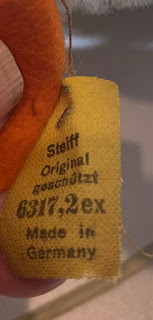
Goose's yellow tag is unusually descriptive in this case and helps to nail down her birthyear.
The words on it include "Steiff Original geschuzt (protected)"; this copy was only used in the late 1940s and very early 1950s. And the numbering is quite telling as well. It reads, 6317,2 ex. This means, 6 = young, 3 = mohair, 17 = 17 cm, ,2 = double press voice, growler, or pull cord voice, and ex = on eccentric wheels. She also has her raised script button but no evidence of a US Zone tag. All of this information suggests that this particular goose on wheels was produced probably around 1952 or 1953.

Steiffgal hopes this discussion on this timeless toy has made you feel young at heart today.

Have a question about one of your Steiff treasures? Let's talk! Click here to learn more.

Sunday, October 27, 2019

Is This Turn of Last Century Mohair Goose The Wheel-Deal?

Heads up - there's a goose on the loose! Steiffgal recently came across a most interesting, and very vintage, goose on wheels. His early and endearing presentation, traditional and legacy set of materials, and turn-of-last century manufacturing details certainly appear very Steiff-like. But he does not have any identification, and does not appear in any Steiff reference book or catalog Steiffgal knows of. Take a peek - what do you think?

This fine feathered friend is certainly on a roll. He is standing, unjointed, and measures about 18 cm tall and 28 cm wide. Goose is made from all white mohair and is solidly stuffed with excelsior. His wings are dimensional, stretch backward, and are tacked to his body with a few stitches. His neck is long and graceful. His face comes to life with black button eyes backed in faded red felt, a yellow felt beak, and prominent brown detail embroidery stitching that goes from his eyes to his beak. He glides along on a carriage with four wheels that have traces of gold paint on them. Steiffgal tested the entire rolling mechanism with a magnet and it is made from solid metal.

After much searching around, Steiffgal came across a good picture of a similarly styled goose that Steiff had in the line at the turn of last century. That long-necked bird was standing and had jointed legs. He was made from white mohair, had a yellow felt beak and legs, and almost the identical facial features and detailing - including stitching from the eyes to the beak - as this one on wheels. Steiff's standing, jointed goose was made in 17, 22, 28, 35, and 43 cm from 1911-1918. You can see this goose here on the left, it was sold at Christie's in 2010 along with a smaller farm friend. Together the pair realized GBP 1,375.

So what's going on with this easy rider? Here is a possible explanation, with the tell-tale hint in his wheels. Steiff introduced its wooden up-and-down "eccentric" wheels around 1912 and holds a patent on this mechanism. Eccentric wheels were discovered accidentally, but Steiff quickly realized the product-development opportunities created by their roller drilling mistakes. Birds of all sorts were ideal for eccentric wheels, given their natural "waddling" tendencies, and you see wooden eccentric wheels on many Steiff bird models from 1912 onward.

Now let's shift the discussion into fifth gear. This goose is clearly on metal, not wooden wheels. His pattern, as noted above and given he is Steiff, was introduced in 1911, BEFORE wooden eccentric wheels were in the line. It is possible that in 1911 or early 1912, Steiff wanted to see if their existing standing white mohair goose pattern could be modified as a pull toy on metal wheels - and this example could be the result of that experiment. It is interesting to note that Steiff introduced a new mohair goose on eccentric wooden wheels soon after in 1914. This updated pattern, having an orange felt beak and feet, grey and white coloring, a shorter neck, and a more compact body, appeared in 14 and 17 cm prewar through 1943 overall. You can see that updated goose on wheels here on the left; the picture is from Pfeiffer's 1892-1943 Sortiment. 

Steiffgal hopes this discussion on this unusual and probably Steiff goose knocked you over with a feather.

Have a question about one of your Steiff treasures? Let's talk! Click here to learn more. 
The teddy bear search engine