Thursday, December 31, 2009

Clowning Around With Steiff

Steiffgal's not joking around when she says Steiff has a long and rich history of producing wonderfully entertaining clowns!

Over the 130-year his
tory of the company, these playful pranksters have appeared in just about every form you can imagine. They have been produced as dolls, ball-dolls (figures with a goofy ball shaped bodies and "normal" limbs), musical figures, pom-pom characters, skittles (perched on wooden pins for a bowling style game), and roly-polys (on half-spheres that wobble about). From what Steiffgal can tell, the first clown appeared in the Steiff catalog in 1894 as a 28 cm doll with a felt body and colorful felt clothing.

Since clowns can't help but bring a smile to your face
, what would be a better way to welcome 2010 than a quick look at some Steiff's more recent "clown highlights?"


Kicking off ou
r clown parade is Clownie. This fabulous funnyman was produced from 1956 through 1975 in 14, 19, and 43 cm. He was also available as a 120 cm display piece by special order. The smallest Clownies had hard rubber heads and bodies, while those 19 cm and larger had fabric bodies with movable arms. Clownie sports blue felt patched pants (patches are on the front and back of his trousers), a white calico shirt, white gloved hands, and black felt shoes and hat. Leveraging a good thing, Steiff produced this beloved Clownie design as a 17 cm hand puppet from 1967 through 1976.

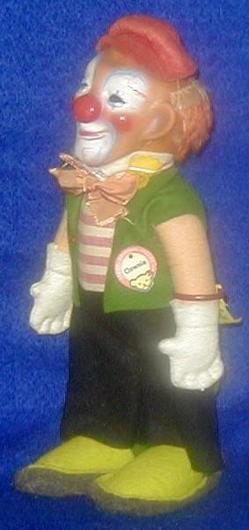
Steiff also produced another clown named Clownie from
1954 through 1955. He was made in 14 and 19 cm and was attired in a green felt jacket, black felt pants, a red and white striped shirt, black felt pants, yellow felt shoes, and a red felt cap. This Clownie is very rare and collectible due to his extremely limited time in the catalog. Interestingly, the production methods for both Clownies are based on lessons that Steiff learned from the large scale manufacturing of both the Mecki and Micki hedgehog dolls from the early 1950's.


Let's extend the hand of friendship to this next Steiff clown. This is Hand-Kasper Happy or Hand-Punch Happy. This perky puppet is 17 cm tall and is detailed with red and gold felt clothing, red wool pom-poms, and a white felt neck ruff. He is wearing a gold felt hat with a bell on the end and white felt gloves. He was in the line from 1963 through 1974; those up to 1972 had plastic heads, those after 1972 had softer PVC heads. It is interesting to note that the same head design was used in 1964 as a Blacky Chimney Sweep puppet. Moving forward, Steiff used this very successful basic design template for many puppets by varying the hairline and costumes through the early 1980's.


The next Steiff clown in this lineup is Cappy Schlenkerpuppe or Cappy Floppy Doll. This silly softie stands 28 cm and was produced from 1968 through 1974. He is unjointed and designed for fun and play. This Cappy has a plastic head, yellow felt cap with a bell, while felt glove hands, and red felt feet. His costume is a red and blue artificial silk "harlequin" style suit with a white felt neck ruff.


Notice Cappy's face and head? It is the same as Hand-Punch Happy mentioned above. Steiff also used this very popular face and head for other dolls including a caveman and a sandman; these were produced in the same general time frame as Cappy.


Our parade is slowly drawing to a close, and that's a big deal. A 70 cm deal. This very big boy is Schlori Kasper or Schlori Punch. Schlori was produced from 1978 through 1980. Earlier Schlori dolls were made from synthetic velvet while the later versions were made from trevira velvet. Schlori has a pointy cone nose and soft plush blond hair. He is completely unjointed and very floppy. He wears a red felt hat, red shoes, and an orange and green "harlequin" suit which is finished with a white felt neck ruff. This identical design was also produced in 40 cm as Lari Kasper or Lari-Punch, and Fari Kasper or Fari-Punch. Lari has brown hair and an orange and green suit, while Fari has black hair and an orange and red suit.


And finally why does the word "punch" keep showing up in reference to some Steiff clowns? Probably in reference to the famous "Punch and Judy" puppet shows that were very popular across Europe in days past. The "Punch" character was a "clowny" jester who traditionally wore a playful harlequin style costume, called a "Motley."


Steiffgal ho-ho-ho hopes this optimistic review of Steiff clowns helps to set you up for a very happy and jolly 2010!


Have a question about one of your Steiff treasures, comical or otherwise? Let's talk! Click here to learn more.

Sunday, December 27, 2009

Steiff's 12 Days of Christmas - Part 2

... And picking right up where we left off last week - without further delay - the second part of "Steiff's 12 Days of Christmas!"

On the seventh day of Christmas my true love gave to me... seven swans a-swimming. Take a look at this lovely all black swan, which as far as Steiffgal can tell, is the only one Steiff has ever made! Schwan, or swan, is 20 cm, unjointed, and made from women fur. She has tiny red webbed feet and a red beak. She was produced from 1983 through 1985 and also came in all white. The first Steiff swan appeared in the 1892 debut catalog; according to the 1892 - 1943 Steiff Sortiment book, she was described as "felt, white, lying in a nest of knitted moss, colorful felt pad, painted, also usable as an ink wiper." Boy, how times have changed!

On the eighth day of Christmas my true love gave to me...eight maids-a-milking. Let's make it "chocolate milking" to add a little holiday fun to our story! Milka Kuh or Milka Cow is one of the best known and loved advertising characters in Germany. This purple cow is the logo of Kraft Food's specialty chocolate brand Jacobs Suchard, which has been in business since 1901. It is thought that her name, Milka, came about from combining Milch and Kakao (the German words for milk and cocoa, the candy's primary ingredients.) Milka is made from purple and white woven fur and wears a leather color and bell. She was produced in 23, 32, and 75 cm (the largest being a special window display piece) and appeared in the Steiff catalog from 1997 through 2003.

On the
ninth day of Christmas my true love gave to me... nine ladies dancing. And oh so prettily! From 2004, this is the "Vienna Ballerina Teddy Bear", a limited edition of 1,500 pieces produced exclusively for Austria. She is five ways jointed, made from apricot mohair, and stands 32 cm tall. She is elegantly dressed in a silken tutu and wears laced-up ballet shoes. And what is dance without music? This dancing darling comes with a music box that plays the "Wiener Blut" or "Viennese Blood Waltz", a popular piece of classical music composed by Johann Strauss II in 1871.

On the te
nth day of Christmas my true love gave to me... ten lords-a-leaping. Now here Steiffgal must confess.. that this is her FAVORITE day, and favorite gift, in this version of Steiff's 12 days of Christmas. Imagine these "Lords" a-leaping. Here we have Lord, the Great Dane, which Steiff produced from 1932 through 1936. (This picture is from Pfeiffer's 1892 - 1943 Steiff Sortiment book... a "must have" resource for all things Steiff.) Lord is sitting, unjointed, and made from a hearty fabric which has been carefully airbrushed with brown spots. He was produced in 17, 22, and 28 cm. He was also manufactured in a similar standing design, during the same time period. Lord was the first, and as far as Steiffgal can tell, the last Great Dane produced by Steiff.

On the ele
venth day of Christmas my true love gave to me...eleven pipers piping. There's no rule that pipers can't be heavenly, right? That being the case, this Teddy bear angel with a transverse flute ornament from Steiff's 2004 worldwide limited edition holiday collection should fit the bill here just fine. This perfect piper is 11 cm, five ways jointed, made from blonde mohair, and is adorned in a sky-blue gown to match her distinctive eyes. Of course, she has her requisite angel-wings. And just what is a transverse flute? It's a relatively simple, ancient wind instrument, possibly first seen in Chinese art from the 9th century BC.

Drum roll to t
he finale here please... on the twelfth day of Christmas my true love gave to me... twelve drummers drumming. But why just stick with drums when the whole band is available to celebrate the 12 days of Christmas? Here we have Steiff's wonderful and highly collectible Circus Band Set from 1988 and 1989. The set, which was made in an edition size of 5,000 for the USA, consists of five fabulous musicians, including a Teddy bandmaster (bottom left), a dog trombone player (top center), a cat with a drum (top right), a lion with a tuba (top left) and a crocodile with a trumpet (bottom right.) Each player is 19 cm, fully jointed, dressed to the nines in their marching attire, and made from mohair. These jolly players were part of the larger Steiff "Golden Age of the Circus" series, which included clowns, acrobats, balloon sellers, a fat lady, fire eaters, strong men, and other traditional "big top" entertainers.

Readers, Steiffgal hopes that this Steiff-y take on the twelve days of Christmas has helped to set you up for a very happy New Year's celebration and a healthy, successful, and personally fulfilling 2010.

Have a question about one of your Steiff treasures? Let's talk! Click here to learn more.

Monday, December 21, 2009

Steiff's 12 Days of Christmas - Part 1

Here's a little known fact... the 12 days of Christmas actually begin on Christmas day and last through January 5th! This special time, also known as Christmastide, inspired the universally beloved Christmas song, "The Twelve Days of Christmas." The "cumulative style" carol was first published in England in 1780. All of this got Steiffgal thinking... what would the 12 days of Steiff Christmas look like? Alot of Steiff! So here is part one - days one through six. Check back here early next week for part two - days seven through twelve!

Now, without further adieu, let's strike up the band and get started!

On the first day of Christmas my true love gave to me...a partridge in a pear tree. Surprisingly, Steiffgal cannot find any indication that Steiff ever commercially produced a partridge bird in any of her reference books. New product idea, perhaps? Since a partridge is a mostly grey, chubby bird with red feet, this little fellow will have to do the trick for now. Here's a vintage, well loved 12 cm Steiff Fink or finch from 1955 through 1957. He is made from mohair and has tiny red metal legs.

On the second day of Christmas my true love gave to me...two turtle doves. Interestingly, the German word for dove and pigeon is the same... Taube. The first taube appeared in the Steiff line in 1894 - just two years after the debut catalog of 1892 - as a white felt bird on an elastic string. This modern clip-on dove is 10 cm, made from white alpaca, and has lovely airbrushed felt wing and tail feathers. She was produced in 2004 as part of the North American limited edition collection.

On the third
day of Christmas my true love gave to me...three French hens. Steiffgal hopes you enjoy this tourist photo, taken of Woll-Henne or Woolen Hen, on her most recent trip to Paris! Hen is one of Steiff's famous "woolen miniatures", the tiny "pom-pom" style animals Steiff first introduced in the 1930's. This particular 8 cm hen was produced from 1949 through 1982 and has a red felt comb, grey felt tail feathers, yellow felt beak, googly plastic eyes, and red metal legs. She was also manufactured in the identical pattern pre-war from 1938 through 1943.

On the fourt
h day of Christmas my true love gave to me...four calling birds. Steiffgal can't imagine a better bird-buddy to have on the phone than a parrot! This is Papagei Lora, or Lora Parrot. She is 12 cm, is made from brightly colored mohair, has felt feet, a delicately detailed facial mask, a rubber beak, and piercing green pupil eyes. She appeared in the Steiff catalog from 1962 through 1976. She was also produced in 22 cm from 1962 through 1974. The first Steiff parrot was appeared in the catalog in 1892 and was made from felt; she was available with or without a wire swing for display.

On the fifth day of Christmas my true love gave to me...five golden rings. Well, Steiff hasn't entered the fine jewelry business yet, but Steiffgal is saving her pennies for that day if it ever comes! In the meantime, check out this all-season sparkler, the Steiff Swarovski Teddy bear pendant! Teddy is 2.8 cm, has a gold-plated muzzle, eartag, and paws, and is covered head to toe in 120 clear hand-set Swarovski crystals. His eyes and nose are black enamel. That's some blinged-out bear!

On the sixth day of Christmas my true love gave to me...six geese a' laying. To mark the halfway point in our Steiff twelve days of Christmas review, here we have a darling trio of Steiff geese. The goose on the far right is Gans Tulla or Tulla goose. Tulla was produced from 1952 through 1974 in 12, 17, and 28 cm. Tulla is made from white mohair and has delightfully playful orange felt webbed feet and beak. The goose on the left and in the middle is Kuschi Gans, or Kuschi goose. Kuschi was produced in 12 cm from 1962 through 1970 as a "special order" promotional item for a bedding company. The only difference between Tulla and Kuschi is that Kuschi is detailed with white feathers on her tail or head.

Readers, Steiffgal hopes part one of the Steiff "Twelve Days of Christmas" review has put a happy holiday song in your heart. Check back in a few days for part two!

Have a question about one of your Steiff treasures, seasonal or otherwise? Let's talk! Click here to learn more.

Thursday, December 17, 2009

Steiff Holiday Greetings - From 1913!

Steiffgal hopes that all of her readers have mailboxes full of seasonal holiday cards from friends near and far. Hopefully you have room for one more from Steiffgal! This one features a tree, but didn't take a tree to produce as you can view it online!

Take a look at this wonderful vintage Steiff Christmas scene from around 1913. (You can click on the picture to enlarge it.) This image is from the delightful book Advertising Art of Steiff Teddy Bears and Playthings by Dottie Ayers and Dona Harrison. This vignette was actually produced as a black and white print advertisement for the German publication Illustrirte Zeitug. This was a popular weekly current events magazine that featured news reports; home, garden, and fashion articles; culture and lifestyle columns, and extensive advertising. The publication had a very high circulation for its time.

Let's take a look at the ad piece by piece.
First the writing. The copy on the top left of the picture translates approximately to: "Toy factory Margarete Steiff, GmbH, (Wurttenberg). Founder and manufacturer of the world famous "Teddy bear." Trademark "Button in Ear." Grand Prix St. Louis 1904 and Brussels 1910. International building trade exhibition Leipzig 1913: State Award. Available everywhere. No direct sales to private parties. Catalog #20 free." This is basically presenting the company's trademark, highlighting early awards won, and telling consumers that they must purchase their items through a retailer's store - not directly through Steiff. However, they public could request a catalog at no charge.

Now to the fun... the items displayed in the ad! From left to right they are: a 9 cm plush play ball ($0.19), a 50 cm ride-on goat ($4.80), a 25 cm record Teddy ($0.96), a 35 cm little boy doll named Heiner ($1.32), a tiny white mouse ($0.10), 17 and 22 cm white lambs on wheels ($0.41 and $0.65), a 35 cm little girl doll named Rosa ($1.56), a 25 cm record Peter monkey ($1.14), and a 50 cm ride-on donkey ($4.80). On the tree, left to right, if you look closely you can see a 8 cm pigeon ($0.22), a white felt swan with woolen pom poms ($0.22), 12 cm velvet squirrel ($0.29), a white felt rabbit with woolen pom poms ($0.22), and an 8 cm "good luck" pink velvet pig with a clover in his mouth ($0.17).

And the dollar figures listed after each one? That's how much each item cost in US dollars in 1913! But just to put things in perspective, the average weekly salary back then, based on a six day workweek, was about $17!


Clearly, Steiff has played a role for many families at Christmas since the company started producing its wonderful items on an international scale at the turn of last century. However, it is curious to note that none of the items pictured in the seasonal advertisement were actually specifically made for Christmas. Most interestingly in this regard are the tree "ornaments". The pigeon, swan, and rabbit were all designed as "pram toys" or items to hang from a baby's stroller. The squirrel was a popular plaything, and the pig was intended to be a pincushion. After combing through many Steiff reference books, the earliest Christmas specific Steiff item Steiffgal could find was a brightly painted 20 cm wooden Santa Claus toy on a rocking base. This item was featured in the catalog from 1923 through 1927. To the left is a black and white picture of this item, which is taken from Gunther Pfeiffer's 1892 - 1943 Steiff Sortiment reference book.

Christmas became a higher priority for Steiff after WWII.
Sa
nta Claus as we know him now made his grand debut in the Steiff catalog 1953 as a five way jointed 31 cm doll with a rubber head, felt body, bright red felt suit and cap, and white fluffy mohair beard. By 1955 this design was also being produced in 13 and 18 cm as well as a special order 150 cm display piece. From 1954 through 1961 this Santa pattern was also produced as a popular and highly sought after 21 cm hand puppet. This original beloved Santa Claus doll was reissued in 19 and 28 cm as a US exclusive from 1984 through 1988. Christmas really kicked into high gear at Steiff in the late 1980's with the production of several Santa Claus Teddies. A series of limited edition Christmas tree ornaments for the US market was launched in 1994.

Today, Christmas
items are a very important part of the Steiff product line. Each year, numerous worldwide and country-wide limited editions are produced, and several retailers - including FAO Schwarz - have traditionally produced their own exclusives in conjunction with Steiff. A few years ago, Steiff started producing a series of Christmas specific soft plus playthings and baby toys. This 25 cm green, soft plush decorated Weihnachtsbaum or Christmas tree from 2005 - one of Steiffgal's treasured oddities - is a good example of Steiff's relatively new "outside the box" thinking about Christmas. This seasonal showpiece was a holiday gift from Steiffgal's friend Steiffpal a few years ago.

Dear readers, may you find that one Steiff item you have always wanted under your Christmas tree, tucked next to your menorah, or adjacent to your Kwanzaa kinara centerpiece! But more importantly, Steiffgal hopes this time of joy and celebration - however you personally celebrate the season - brings you peace and happiness in very real and meaningful way.

Have a question about one of your Steiff treasures, Christmas related or otherwise? Let's talk! Click here to learn more.
The teddy bear search engine