Sunday, July 25, 2010

Oh My! Oma's Great Makeover

It's a makeover worthy of an appearance on the Oprah Winfrey Show!  A few months ago, Steiffgal was unbelievably lucky to acquire a 22 cm Steiff felt doll from the 1920's.  Steiffgal decided to name her "Oma", as that was the name of her original owner.  Oma arrived perfect in every way, except for one thing... her attire.

As typical in many cases, antique dolls often appear today in clothing that is not original to their production.  And why is this?  Dolls are design for play, and dressing and undressing them is all part of the fun.  Doll clothes are small and easy to misplace during wardrobe changes.  Additionally, mothers sometimes made doll's clothes from fabric scraps left over from other sewing projects.  These outfits, sometimes matching those of their little girl owners, were often greatly preferred over the dolls original attire.  Pictured here on the left is Oma as she first appeared to Steiffgal earlier this summer. 

Steiffgal is certain that the outfit that Oma arrived in was not the one she left the Steiff factory wearing almost a century ago.  And, her gut feeling is that her delightful orange peasant style dress and floral cap were loving created for her by a talented mother-seamstress, not Steiff.  With the help of European toy expert Ingrid Robson, it was determined that Oma most likely was the Steiff doll model Meta, who appeared in the Steiff line from 1917 through 1919.  Meta is pictured here on the left; this photo is taken from Gunther Pfeiffer's 1892-1943 Steiff Sortiment book.

And here's where the stylists come in.  With expert precision, Ingrid recreated Meta's original outfit for Oma.  Using vintage materials and fabrics, Ingrid created "old/new" period underwear, a frock, matching hat, and shoes for her.  Oma and her new wardrobe are pictured just below... note how closely her outfit closely matches that of Meta!  

According to Ingrid:
 "The bonnet and dress were made using only the picture from the Steiff Sortiment as a guide. The knickers were my own design and the petticoat was taken from the one she was wearing made to match the knickers. As the doll in the picture (Meta) was not wearing shoes I modeled them on the shoes worn by another doll "Marga", from the same time period.  All the clothes were made from old material, the shoes were made from new felt but of good millinery quality. The underclothes were made from a fine cotton lawn actually taken from a damaged Edwardian christening gown. The dress and bonnet were made from a cotton muslin with 'flocked' spots. I bought this many years ago in a job lot in auction and it comes in very useful for dresses for old dolls. The new felt was bought from a little shop in Vienna where I buy most of my felt, they have a good range of colors and qualities not easy to find in the UK these days."

Ingrid continues:
"I am a great believer that dolls not having their original clothes should have ones made with the fabrics from their era including trimmings if possible. I hate to see modern nylon lace trimmings on early 20th century dolls. To this end over the years I have accumulated material and trimmings to cover the mid-nineteenth century to the 1950's. Up to about 10 years ago you could always rely on finding boxes in auction but not so any more. I look for remnants and old clothes in charity shops, antique markets, and other like places.  These days and many of the people in the area I live know I am always on the lookout and sometimes come with bits and bobs especially if someone dies or granny or mother is going into a home and they are sorting out their things."

It's safe to say "what's old is new again" in terms of Oma's beautiful makeover.  Steiffgal wholeheartedly recommends Ingrid's services for other collectors interested in restoring their Steiff dolls to their original attired condition.  Check out her website at  http://www.austrobear.co.uk/.

Steiffgal hopes Oma's makeover will inspire you to have a beautiful day as well.

Have a question about one of your Steiff treasures? Let's talk! Click here to learn more.

Thursday, July 15, 2010

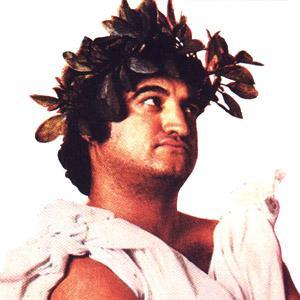
Steiff's Very Own Roman Emperor

Friends, Romans, countrymen, lend me your ears... so Steiffgal can tell you a little bit about a Steiff bear with "ancient" origins!  Check out this note from Harald, from Coppell, Texas, who asks about his noble Steiff bear purchased at FAO Schwarz.  He writes and provides the following information:

"Greetings Steiffgal:

I bought this Roman Bear from FAO Schwarz in Dallas shortly before they closed the store a few years ago.  This particular noble Emperor is number 00756 out of an unknown total quantity.  

His name is Augustus, and he is made of mohair and is dressed in a toga and cape. He stands 9" tall and is fully jointed.  Augustus is one of many Roman Bears. The other Roman Bears were issued in 1992 through 1993 in Germany with different ones issued to different cities and States within Germany. These were to commemorate the Romans coming up from Italy to conquest and govern the Germanic Empire.

Do you know how many were made overall?

Many thanks, Harald"

Steiffgal feels like an empress having the opportunity to research this byzantine inquiry!  And, for better or worse, the answer itself will be patched together like the shards of an ancient vase. 

Harald's Augustus has a very interesting story behind him.  As mentioned above, in 1992 through 1992, Steiff had produced a series of Ancient Roman themed bears for Europe.  These bears were all dressed in a white toga - like dress and had a wreath of olive leaves around their heads.  Each was detailed with a full length red body sash that had the name of the bear embroidered in gold on the back.  Every bear came with a certificate which explained the history and origin of that particular Roman bear.  These Roemer Baeren, or Roman Bears, were each produced for a different retail outlet in Europe, so collectors who wanted the entire set had to go to each store to collect the exclusive bear.  These ten bears are pictured here above; the photograph is from the Cieslik's wonderful Steiff-Teddy Bears Love For A Lifetime book. 

Here is a breakdown of the series, including the name of the bear, the retail store that carried it, its year, and its edition size:
  • Ursulus, Fedhaus Cologne, 1992, edition size of 1,000
  • Severus Alexander, Behle Frankfurt, 1993, edition size of 300
  • Titus Julius Saturninus, Toy Museum of Trier, 1993, edition size of 300
  • Imparator Caracalla, Abele, Aalen, 1993, edition size of 300
  • Cajus Valerius Crispus, Toy Shop at the Market, Weisbaden, 1993, edition size of 300
  • Caius Fulvius Lupus, Puppenkonig, Bonn, 1992, edition size of 300
  • Imperator Vespasian, Wolff, Giengen, 1993, edition size of 300
  • Baccharus, Stiehl, Bacharach, 1993, edition size of 300
  • Drusus, Joosten and Kloeden, Neuss, 1993, edition size of 300
  • Bodvoc, Teddy Bears of Whitney, 1993, edition size of 300

So this wonderful Roman collector's series appeared in the early 1990's and Augustus appeared in the late 1990's.  What's the connection?  It is interesting to note that the FAO Schwarz in Las Vegas opened in the Forum Shops at Caesars Palace in 1997.  The store had a strong "Roman" theme, complete with a 48 foot tall "Trojan horse" that greeted every visitor at the entrance to the store.  You can see this horse on the picture here to the left.  Steiff has always been an integral partner to FAO Schwarz, so of course FAO Schwarz wanted a great exclusive Steiff product to help celebrate the launch of this new world class destination store.  What could be better than a Steiff Roman Emperor who had already proven his popularity overseas?  Thus, Steiff slightly updated their 1992 through 1993 "Roman" bear model and introduced Augustus to America in 1997 through FAO Schwarz.  What a perfect fit!  (Most unfortunately, this Las Vegas closed a few years ago; the storefront now boasts to be the largest H&M store in the USA...)

Now for the more tactical question... so how many Augustus bears were made?  Steiffgal cannot find any reference to an exact number.  But there are a few clues that can be used to extrapolate a reasonable number.  First of all, this bear was only sold at FAO Schwarz stores.  Historically, around the late 1990's, Steiff would make edition sizes no larger than 2,000 for FAO Schwarz.  The other earlier Steiff Roman bears were produced in edition sizes ranging from 300 to 1,000 pieces... giving an indication of sales expectations for these limited pieces. Finally, we know for certain that Harald's bear is number 756.  Given all of that information, it would be Steiffgal's best estimate (guestimate....) that Augustus was made in an edition size of 1,000 pieces, to keep within the FAO Schwarz edition size guidelines, but on the low size to make sure demand was higher than the supply to generate excitement among collectors.  

Steiffgal hopes this trip through Steiff's land of ancient Roman celebrities has put you in a toga-party frame of mind.

Have a question about one of your Steiff treasures? Let's talk! Click here to learn more.

Saturday, July 10, 2010

Solving A Lifelong Steiff Mystery

Steiff Teddies and animals are truly friends for life.  Steiffgal is certain that many "grown up" SteiffLife readers have a very special Steiff Teddy or animal from childhood in their lives today.  Check out this note from a reader from Maryland who writes about her mystery kitten friend who has been her constant companion since nursery school.  Could Mittens be a Steiff?  

Amy writes...

"Back in 1975 or '76, when I was leaving nursery school, my teacher let me take home my favorite toy from the toy boxes because I could not bear to be parted from her.  She had been left there by a previous student.  I have loved her, sometimes quite hard, for many years since; she has had her eyes replaced and she's been repeatedly washed, and she's much more worn now, though she was hardly pristine then.  

I've always wondered where she came from, as I've never seen a stuffed cat quite like her. Today I was bored, and I started messing around online, and found your Flickr photos, particularly this one: http://www.flickr.com/photos/26126533@N05/4392157977/  

Is my Mittens one of these?  She had no tags when I got her, not even the more expected commercial tag off the hip or leg, but she matched the image once upon a time, with bigger green eyes and the pink embroidered nose (now mostly worn away).  She does still have the whiskers, though they're not visible in the photos, and her head swivels.  Her stuffing is soft and her legs are made to fold at so she can sit.  She's almost 14" from ear tip to foot.  

I'm not interested in "value"--she's far too well-loved to be worth anything to a collector!  I'm just curious as to her origin.  I never expected her to be a Steiff, but it's such a close match; but then, for all I know, she's a bootleg.  *grin*  

Thank you so much!  

Amy"

Amy, that was some special friend your teacher gave to you way back when!  And yes, she is one of Giengen's famous exports, a "friend for life."  What you have here is Steiff's Dangling Tom Cat. She is head jointed and made from grey and white dralon fur. She has green and black pupil plastic eyes, mono-filament whiskers, and a hand embroidered pink nose and mouth.  She is 13 inches tall and was made from 1969 through 1976, which perfectly aligns with your history with her.  The picture here to the left shows what your dear friend looked like when new; Steiffgal also has one of these fabulous felines in her collection.

It is interesting to note that Dangling Tom Cat also has a "sporting side."  From 1972 through 1977, Steiff also produced this cat attired for a good workout.  She was the identical size and shape, and had the same face and coloring.  However, her arms, legs, and torso were blue, to appear as she was wearing a track suit. She also had a red scarf. Her arms were detailed with white and red stripes, giving her a "blue ribbon" appearance.  The picture on the left shows "sporty Tom Cat"; the illustration is taken from Gunther Pfeiffer's Steiff Sortiment 1947 - 2003 book.   Steiff also gave a similar same athletic treatment to Zotty Teddy bear (dressed as a hockey player and produced from 1972 through 1975); Lulac rabbit (dressed as a skier and produced from 1972 through 1974); and Jocko the chimp (dressed as a football player and produced from 1972 through 1973).
Steiffgal hopes that solving this little Steiff mystery hasn't been too much of a workout for you!
Have a question about one of your Steiff - or maybe Steiff - treasures? Let's talk! Click here to learn more.

Friday, July 2, 2010

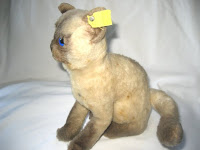
This Mystery Steiff Feline is the Cat's Meow!

Isn't it great when an unexpected Steiff find ends up being the cat's meow?  Check out this inquiry from Karen about a most fantastic feline.  Karen runs an antique shop out of a restored 1880's blacksmith shop in North Dakota!   Through a series of communications she writes...

"I got your email address off of the internet and would appreciate any help you can give me in identifying the age and information for this Steiff Siamese cat I recently acquired.  

The button is more brass colored with Steiff in script lettering. The only words I can make out on the eartag are "Original Steiff, Made in Germany" on the front; the back says something about dralon and cotton.

Any help you may have is so appreciated.  It's AMAZING the number of animals this company has made!

Thanks again,

Karen"

A collector could go cat-atonic looking for this most unusual kitten!  At first glance, Steiffgal thought she was Cosy Siamy, a very dear 22 cm dralon Siamese cat with gigantic blue eyes.  Cosy Siamy was produced from 1970 through 1979.    However, Cosy Siamy is standing while Karen's kitty is sitting.   Additionally,  Cosy Siamy has a pink nose while Karen's cat's nose is brown - but Steiffgal has seen both pink and brown noses on various Steiff Siamese cats over the years.  

One of the very cool things about Karen's cat is its relatively rare button-in-ear.  This cat has the brass raised script button, which was only used from 1978 through 1980.  So, the cat's button precisely dates her manufacture to the 1978 to 1980 time frame.  This rarely seen brass "knopf" closely resembles the raised script nickel button used throughout the 1950's and 1960's.  

Steiffgal cannot find a sitting version of a dralon Siamese cat in the standard reference books.  So in which "nine lives" in the history of Steiff does this curious cat belong?   Steiffgal's best guestimate is that she is indeed a sitting version of Cosy Siamy, based on her similar look, material, and unusual brass button dating. (A picture of the "real" Cosy Siamy is pictured above on the left for reference; the photo was taken from Gunther Pfeiffer's 1947 - 2003 Steiff Sortiment Book.)  Karen's cat was produced towards the end of Cosy Siamy's run in the catalog; perhaps she was intended at one time to be the next iteration of this blue-eyed beauty? 

As for value, Steiffgal needs to approach this question on little cat's feet.  As always, Steiffgal is not a formal appraiser and believes that something is "worth" what someone else will pay for it.  It looks like this cat has been loved quite a bit - which is expected, given her appeal - but it does takes down the "collector's value" a little.  But because she has her neat, uncommon button and is not cataloged in the standard Steiff reference materials, she may be valued in the $75 to $150+ range.
  
Steiffgal hopes this research on Karen's mystery cat has everyone sitting pretty!

Have a question about one of your Steiff treasures? Let's talk! Click here to learn more. 
The teddy bear search engine