Wednesday, March 29, 2023

This Midcentury Steiff Cub Is As Sweet As A Chocolate Kiss!

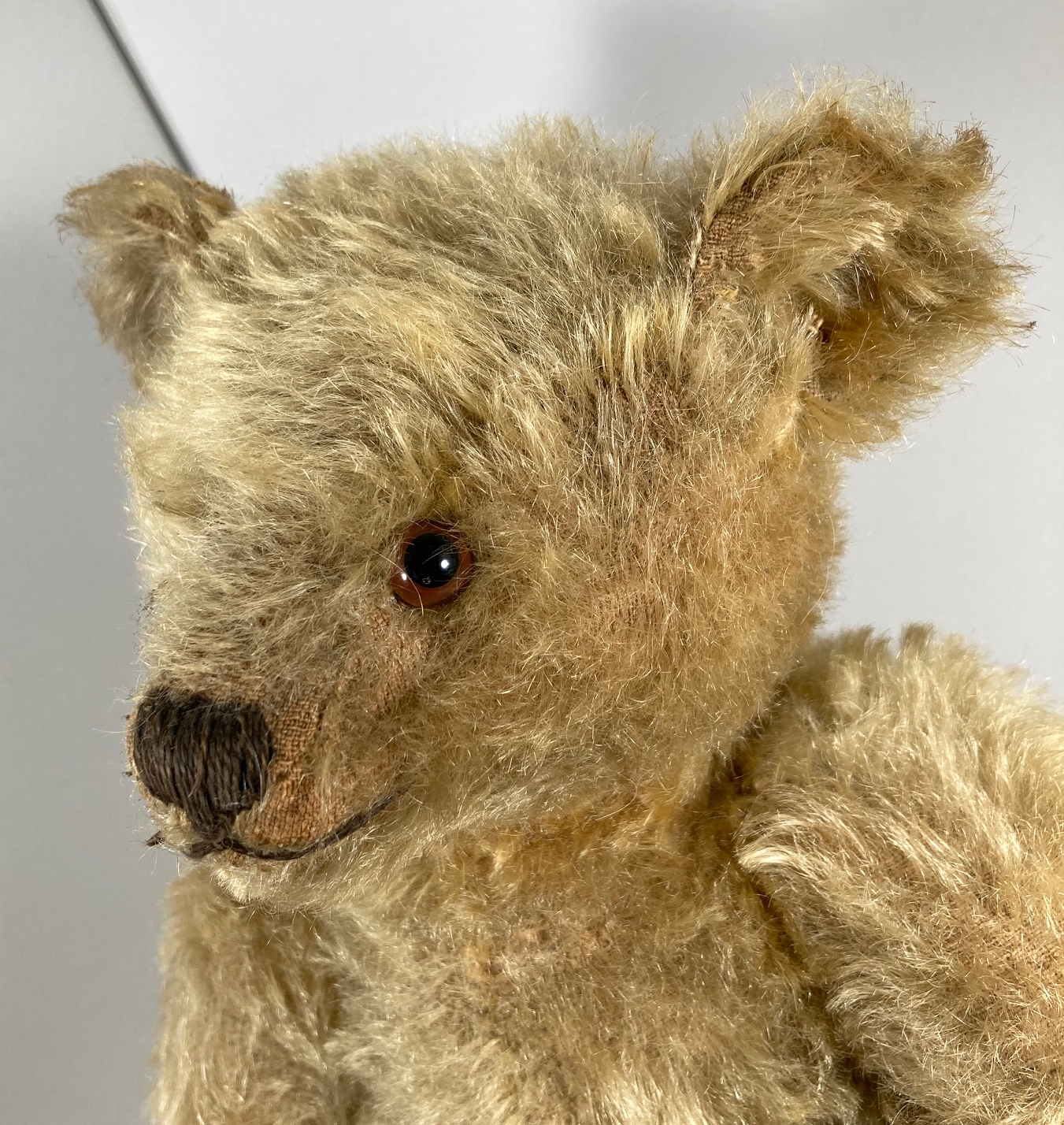
Now here's something you don't see every day! Check out this sweet and unusual Steiff bear. His construction is quite distinctive, most certainly reflecting the realities of manufacturing in the era in which he was "born." Four different fabrics were used to bring this happy handful to life!

What we have here is a sweet as a chocolate kiss Teddy baby bear. He stands 22 cm tall and is fully jointed. His face is detailed with brown and black glass pupil eyes and a black hand embroidered nose. His claws are also stitched in black. He retains his original red collar and named chest tag, along with his short trailing "f" button, as his Steiff IDs. Although only he knows for certain, it is Steiffgal's very best guess that he left the factory in Giengen around 1947 or 1948 as he does not specifically appear in any Steiff or Teddy bear reference book she can identify. 

Teddy baby has several fabric features that date him to the immediate postwar period. His body, head, and limbs are made from short pile artificial silk plush fabric. According to Pfeiffer's 1947-2003 Sortiment, the company did produce a 30 cm brown artificial silk plush Teddy baby bear in 1949. This guy at 22 cm is much smaller, but could still be his distant cousin. Teddy baby's muzzle and the tops of his feet are made of wartime era wool plush, not mohair. This durable fabric was often used in the place of mohair when it was not available or rationed for military purposes. It is not unusual to find Steiff items traditionally made from mohair from the mid-1930s to early 1950s produced in this substitute fabric. It is also interesting to note that Teddy baby's paw pads are made from an inexpensive, thin linen material. These would traditionally be made from felt, which was also in very short supply in the late 1940s. A loving previous owner has done a wonderful job fixing and stabilizing his linen foot pads with stitches and TLC. 

One thing that makes Teddy baby bears so universally precious is their open, felt lined, smiling mouths. And, like all but the smallest versions of this classic pattern, this one also has this charming feature - despite a felt shortage! Steiffgal thinks felt was used here for two reasons. 

The first is that it is possible that the company tried to make the mouth in linen, but it just did not look right. It is also possible that linen could not hold the shape or form required for the pattern. And the second is just how visible the mouth is. It is one of the first things you see on this design, and is so fundamental to its appeal. Making the mouth out of felt on this pattern only required a little more than a square inch of material. So many Teddy baby bears could be importantly detailed with just a touch of felt when the company had minimal felt in inventory. This bear pattern usually also has its hands and feet pads made from felt. But in this case, those areas are not nearly as visible, prominent, or key to its design. Creating this pattern with felt foot and hand pads would require about five times more felt than one that just had a felt lined mouth. This Teddy baby is equally as precious with linen pads as he would be with felt pads... at least in Steiffgal's humble opinion! 

Steiffgal hopes you found this discussion on this very early postwar Teddy baby bear materially interesting!

Have a question about one of your Steiff treasures? Let's talk! Click here to learn more!

Saturday, March 11, 2023

What A Pretty And Petite Steiff Prewar Pup!

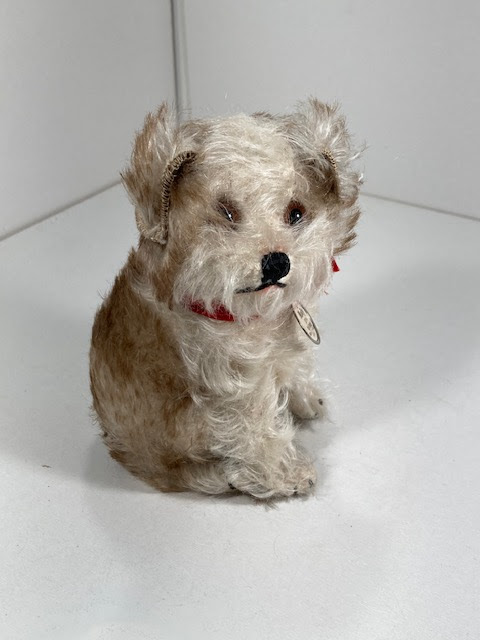
Good things come in small packages. Especially when those things are button-in-ear. Check out this absolutely darling, pint-sized pup Steiffgal just recently added to her collection. He is a little known example from a long legacy of Steiff's prewar Fox Terrier production. Blink and you would have missed him!

What we have here is a seldom seen version of Steiff's late 1920s era Foxy Fox Terrier. He is 10 cm tall, sitting, head jointed, and made from white mohair. He has very distinctive jet black mohair ears. His face comes to life with proportional brown and black glass pupil eyes, a black hand embroidered nose and mouth, and black airbrushing around one eye. He also has traces of black airbrushed highlights around the base of his tail. He wears his original silken ribbon and jingle bell. He retains his prewar styled, red imprinted named chest tag as his Steiff ID. This darling doggie was produced in 10, 14, 17, and 22 cm from 1929-1933 overall. He is pictured here on the left, and a close up of his named chest tag is below. 

Fox Terriers are one of Steiff's earliest dog breeds.
They made their debut in the Steiff line in 1899, just a handful of years after the company's commercial catalog launch in 1892. The earliest ones were made from felt or velvet. Typical to the period, Steiff's debut Fox Terrier came on metal wheels and was made from felt. Mohair became available on a commercial scale in 1903 and shortly after, a broad range of mohair Fox Terriers graced the pages of the Steiff catalog. 

The late 1920s could be thought of as a "best of show" period for Steiff's Fox Terriers.
In 1928 and 1929, the company designed and manufactured two brand new mohair examples that were simply irresistible. All had two solid black mohair ears; rounded, puppy like body proportions; and impish personalities. The first of course, was the one under discussion today. He was also produced standing in 10, 14, 17, 20, and 22 cm through 1933. Another "Foxy" pattern had darling and distinctive airbrushed lines on his forehead and a pert, red, round felt tongue. It appeared in the line from 1928 through 1933 overall in two versions: standing in 14, 17, 22, and 28 cm and sitting in 14, 17, and 22 cm. Both the sitting and standing versions are pictured above; all images are from Pfeiffer's 1892-1943 Sortiment. 

Steiffgal hopes you found this discussion on this little sitting Fox Terrier has been dog-gone delightful for you. 

Have a question about one of your Steiff treasures? Let's talk! Click here to learn more!

Sunday, February 26, 2023

Detailing The Differences Between Steiff and Pappe's Sweet Sitting Puppy Dogs

Good golly - this is NOT a Steiff Molly!
But she is adorable nonetheless, and a great example of how the toy industry has always capitalized on good ideas and best sellers. Take a look at this sweet girl... you can't help but notice several similarities between her and Steiff's beloved prewar puppy matriarch!

This darling, prewar doggie is sitting, unjointed, and stuffed with excelsior. She is 15 cm tall and made from off white and brown tipped mohair. She has black hand embroidered claws on her front legs, a black hand embroidered nose and mouth, a long narrow tail that sticks straight out, and brown and black glass pupil eyes. Her ears are lined in chocolate brown velvet and are stitched to her head. Her ID is a tan cardboard tag printed in red; it is sewn into the seam in her ear. It has the stylized letters M and P on it, and the words "Made in Germany." The M and P are for Moritz Pappe, a toy company that was started in 1869 in Liegnitz, Germany. 

So what is the story behind this mysterious pup?
Let's name her "Polly", as she was made by Pappe and most likely inspired, at least in part, by Steiff's Molly design. It is Steiffgal's best guess that this Polly was made in the mid- to late 1920s as Pappe used this distinctive, initialed ear tag as its product ID at that time. 

Many Steiff collectors are familiar with Pappe's Teddy bears, which often had sweet, babylike qualities to them. However, this company did make a full range of stuffed mohair playthings, and was especially active in the prewar era when Steiff was also taking a worldwide leadership role in soft toy production. Apparently, Pappe just focused on "local" and not global distribution. According to the Cieslik's German Teddy Bear Encyclopedia, "There is... no indication to overseas (i.e., not European) partners or customers so that one can assume that the companies were only concentrated on the European market."

Molly the Puppy design debuted in 1925.
 She is pictured here on the left. She would become the grand-matriarch of Steiff’s vast dog world. Steiff's first Molly dogs were sitting, made from long white and brown tipped mohair plush, had a swivel head, proportionally large brown and black pupil eyes, and a hand-embroidered black nose and mouth. All left the factory in Giengen wearing a ribbon and jingle bell. Pre-war, this sitting model was produced in 12 sizes ranging from 7-80 cm. Sitting Molly was one of the very first models reintroduced post war, reappearing again in 1949 in five sizes through 1969. Molly was a smashing success from her introduction, and is still universally beloved nearly a century onward. 

There has always been alot of "borrowing," as well as form and variation, amongst the toys produced by manufacturers over the years. This is especially the case with best sellers. So it should be no surprise that factories in addition to Steiff would market a two colored, tipped mohair, gentle looking puppy dog. As a matter of fact, it is thought that Molly's design may have been inspired in part by an early 1920s-era puppy named “Beauty” produced by the English company Farnell. It is quite possible that Pappe saw how well Steiff's Molly and/or Farnell's Beauty were selling, and decided to design their own version... with just enough differences to avoid patent infringement. 

Here are a few basic design and construction variations between Pappe's "Polly" (pictured on the right hand side of the comparison photos) and Steiff's "Molly", pictured on the left hand side of the comparison photos.) 

1.  Pappe's version has a long, thin white tan mohair tail; Steiff's has a very short, tipped mohair tail.

2.  Pappe's version had simple hind legs with no claws; Steiff's had well formed hind legs with claws.

3.  Pappe's version was unjointed with velvet lined mohair ears; Steiff's version was jointed with full mohair ears. 
 
Steiffgal hopes this discussion on this dog made by Pappe has made you quite happy.

Have a question about one of your Steiff treasures? Let's talk! Click here to learn more.

Sunday, February 19, 2023

The His-Story Behind A Marvelous Turn of Last Century Steiff Cub

Provenance can add such an interesting dimension to a precious Steiff item. Here's the story behind a beloved family heirloom Steiffgal recently handled for a new friend from the western part of the USA. She was looking to find a new forever home for her Grandmother's bear - a gorgeous, 19-teens era cub. Here's his story!

Maggie shares:

"Here is a little history on this bear, which has been in my family for over 100 years. He was given to my Grandmother by her older brother, when he came home from World War I. She said that he had gotten the bear in France. My Grandmother called him Buster, probably after Buster Brown, and my mother and I called him Mr. Bear.

I put the little black ribbon on him when my Grandmother passed away in 1981. He's never been like professionally cleaned or refreshed or anything like that. I can remember my mother once shaking him in a brown paper bag with oatmeal to clean him off, that would be in the late sixties.

I took him once to an open casting call for Antiques Roadshow, but they said that they didn't want to do any stuffed toys that particular season. They valued him at somewhere between $2,000 and $10,000 BUT they misidentified him as being from the early 1920s.

I've had him for a really long time, and he does remind me of my Grandmother, but as I am nearing 60 now, I realize that I have no one to pass him down to. And I know that 99% of what people leave behind ends up at Goodwill. I would just be interested in maybe selling him to someone who collects bears and loves them."


Now here's more about Buster Brown, or Mr. Bear!
This handsome dude is 40 cm tall standing, fully jointed, and made from lovely dark blonde mohair. Typical to his era, he has a prominent back hump, long thin felt padded feet, pert proportional brown and black glass pupil eyes, a sort of fuzzy muzzle, and a now faded black hand embroidered mouth, nose, and claws. He is stuffed with excelsior, with a nonworking squeaker in his belly. He has a distinctly sweet and childlike look to him. He retains his long trailing "f" button as his Steiff ID. Given his details and history, this charming cub was born in the c. 1915-1919 time frame. A picture of this bear is here on the left - before he hit the spa. 

As Maggie notes, this bear has never had a proper bath in over a century.
So Steiffgal got to work on this. With the understanding that every item is different, and that pre-existing condition issues really matters when it comes to cleaning, this bear totally qualified for a light but comprehensive scrub. His mohair and backing were lush and intact, with no signs whatsoever of dry mohair or rot. Using the technique outlined in this blog and/or in this video, Steiffgal gave him a good cleaning and fluff, and now he looks even more marvelous than ever! The picture here on the left is the bear post cleaning. Look how his fur just glows!

Now Buster Brown, or Mr. Bear, is off to his new home, far far away, where he will be loved and cherished forever per Maggie's wishes.
And look how happy he looks about that!

Have a question about one of your Steiff treasures? Let's talk! Click here to learn more.
The teddy bear search engine