Steiffgal's not sure what the weather's like where you are, but around these parts it's nothing but grey, grey, and grey... mixed with alot of cold! So imagine her delight when she opened her inbox to find this SUPER COLORFUL... and tropical... Steiff inquiry awaiting! Check out this note from a reader who asks about a longstanding and life sized family treasure. Merrill writes:
"Hello Steiffgal,
I have a large Steiff Parrot which we bought at FAO Schwarz in New York for one of my sons, some forty plus years ago. I'm intending to sell it because he no longer has any interest in keeping it. I am enclosing some photos I've taken so you can see what it looks like.
I have been unable to find any information on a large Steiff parrot, 34" in length, and wonder if you have ever seen it before. It does have a Steiff button on one wing tip and you can tell from the photo that it's beak has deteriorated over the years.
I've been in contact with a person who seems to know how to go about repairing it but that is all I've been able to accomplish so far. Were many made? Was it done specially for FAO Schwarz?
Thank you!
Merrill"
Well, bird's the word when it comes to this great parrot! What we have here is Steiff's Papagei Ara or Ara Parrot. He is a studio, or life sized, treasure and measures 50 cm (without the tail) and about 85 cm with the tail. He is standing made from mohair and felt. His facial mask and beak area are made from a rubbery material which tends to disintegrate over time. Ara came in two main colors - red or blue. Merrill's appears to be the red version. Ara was produced for one year only, in 1967. You can see what Ara looked like when he was new in the photo on the left, which is taken from Gunther Pfeiffer's 1947-2003 Sortiment Book.
In terms of rarity, yes, this big bird is quite elusive! Steiffgal has never actually seen one in person. Because he was made for one year only, compounded by his complicated and detailed assembly, Steiffgal would think that very few were actually produced and sold in the mid 1960's. He was in the general line and not an exclusive to any particular retailer. However, it does not surprise Steiffgal that he was purchased at FAO Schwarz. This US retailer has always had a special relationship with Steiff and has a long tradition of getting "first dibs" at the best and most outstanding Steiff inventory - like this life sized parrot!
Sadly, over time, Ara has lost his beak and part of his facial mask. Steiffgal has seen this happen in another rare and life sized bird from 1967 - an owl. Both beaks were made from a material which tends to dry out, crack, and disfigure over time. Steiffgal understands and respects that some collectors are comfortable with restoration and some are not. However, in the case of the owl, because the beak is such an integral part of the presentation, Steiffgal did recommend restoration. You can see the before and after pictures above; the talented Martha Anderson of www.Teddybearrepair.com replaced the owl's beak with a carefully modeled and painted piece of leather. Steiffgal would recommend the same course of action for Merrill's parrot, given how rare and majestic it is.
Steiffgal hopes this discussion on Merrill's parrot has added a spot of color to your day!
Have a question about one of your Steiff treasures? Let's talk! Click here to learn more.
Monday, January 28, 2013
Saturday, January 19, 2013
Good Golly, It's Steiff's Early Dolly!
Oh baby!
That's exactly what Steiffgal exclaimed when she carefully opened the
box from London and unwrapped the treasure it held. Unlike most turn of
last century Steiff dolls, this one was actually made for fun and play
for kids. Let's take a look at this most unusual and seldom seen early
Steiff baby doll, and see what makes it so special from the design and
historical perspective.
This bundle of love is actually called a "throw doll." The doll itself is 30 cm tall, shaped like a bottle or vase, and is entirely made from felt. She is arm jointed only. Her face has the traditional center seam; small blue and black pupil eyes, and a touch of color on her lips. Her hands are simply constructed but you can still see her fingers. Her dress, which is integral to her body, is red, has short sleeves, and a red bonnet. The dress is decorated with cream colored embroidery along the edges and the word "bebe"across the front. She has little flat black shoes on her base, which you can see on the picture below. When she was new, she had a little ruffle on her bonnet, a white tie under her chin, and a "Mama" tilt style working voice.
This delicate dolly was in production from 1908 through 1921. She was made in white felt, red felt, and red velvet in 30 cm only. She was called "Baby Doll Mausi" from 1908 through 1910 and simply Dolly from 1910 onward. It is interesting to note that Steiff also produced the identical design in white mohair and red mohair; these appeared in the line from 1913 through 1917. You can see what these dolls looked like when they were new in the picture below on the left. They are taken from Gunther Pfeiffer's 1892-1943 Sortiment Book.
Despite it's simple pattern, Steiff produced Dolly with a few variations. Some seemed to have mohair wigs, others did not. Steiffgal has even read about a smaller 25 cm version with silk arms! The dress stitching also varied somewhat, with some dresses having elaborate embroidery around the waist, necklines, and bottoms, while others had simple lines. Most interestingly, apparently the name across the front could be customized; in this case, "bebe" implies this Dolly may have been made for the French market.
Steiffgal hopes this discussion on Steiff's unusual early baby dolls has been a delightful playdate for you.
Have a question about one of your Steiff treasures? Let's talk! Click here to learn more.
This bundle of love is actually called a "throw doll." The doll itself is 30 cm tall, shaped like a bottle or vase, and is entirely made from felt. She is arm jointed only. Her face has the traditional center seam; small blue and black pupil eyes, and a touch of color on her lips. Her hands are simply constructed but you can still see her fingers. Her dress, which is integral to her body, is red, has short sleeves, and a red bonnet. The dress is decorated with cream colored embroidery along the edges and the word "bebe"across the front. She has little flat black shoes on her base, which you can see on the picture below. When she was new, she had a little ruffle on her bonnet, a white tie under her chin, and a "Mama" tilt style working voice.
This delicate dolly was in production from 1908 through 1921. She was made in white felt, red felt, and red velvet in 30 cm only. She was called "Baby Doll Mausi" from 1908 through 1910 and simply Dolly from 1910 onward. It is interesting to note that Steiff also produced the identical design in white mohair and red mohair; these appeared in the line from 1913 through 1917. You can see what these dolls looked like when they were new in the picture below on the left. They are taken from Gunther Pfeiffer's 1892-1943 Sortiment Book.
Despite it's simple pattern, Steiff produced Dolly with a few variations. Some seemed to have mohair wigs, others did not. Steiffgal has even read about a smaller 25 cm version with silk arms! The dress stitching also varied somewhat, with some dresses having elaborate embroidery around the waist, necklines, and bottoms, while others had simple lines. Most interestingly, apparently the name across the front could be customized; in this case, "bebe" implies this Dolly may have been made for the French market.
Steiffgal hopes this discussion on Steiff's unusual early baby dolls has been a delightful playdate for you.
Have a question about one of your Steiff treasures? Let's talk! Click here to learn more.
Friday, January 4, 2013
Make 'Em Laugh... With Steiff's Vintage Comic Strip Dolls
It's kind of funny, but Steiffgal has always had a fascination with Steiff's interpretation of famous cartoon figures. So of course she was delighted when a colleague gave her the heads up about a great group of vintage Steiff comic strip dolls coming up for auction at Theriault's January, 2013 "Stars - A Celestial Collection of Antique Dolls" three day event. Three items in particular really caught her eye. Let's take a look and see what makes them so interesting from the design and historical perspectives.
This first selection clearly proves it is possible to become more handsome the older you get! Here we have Steiff's Grosspapa or Grandpa, produced from 1904 through 1915. He is lot #237 and is described as...
"14" (36 cm.) Felt swivel head with press-modeled facial features, pronounced nose, center seam, stitched ears, black shoe-button eyes on felt pads, mohair wig, attached hat, firm ball-shaped stomach with jointed arms and legs, shaped knees, over-sized feet, wearing original sewn-on blue wool costume. Condition: fair, some fading, few moth holes, wig very sparse. Comments: depicted is the comic character "Foxy Grandpa" from the early 20th century comic series, Steiff, circa 1910. Value Points: very rare early doll by the firm, he has an early Foxy Grandpa celluloid pin and a first prize award from a 1944 doll show."
And just who is this silver fox? "Foxy Grandpa," a US cartoon series introduced in 1900, was penned by Carl E. Schultze. It ran through the 1930's. The strip told of the (mis)adventures of a grandfather and his two grandsons. You can see an example of the strip above. Steiff also manufactured the two grandchildren as dolls in the overall 1904 through 1924 time frame. Steiff produced Foxy Grandpa with both a velvet face and a felt face, but the velvet face is much rarer. According to Steiff records, both versions had a press voice box hidden under Grandpa's felt hat. In 1996, Steiff reproduced Foxy Grandpa as a replica in an edition size of 1,200.
It's time to hit the ground running with our next cartoon highlight. Here we have Barney Google and Spark Plug, his faithful racehorse. The pair was produced from 1925 through 1927. They comprise lot #235 and are described as...
"5" (13 cm.) 5"(13 cm.) Barney, 8"l. Spark Plug. The set comprises stockinette Barney with press-shaped and painted features, prominent nose, large felt eye whites with black bead eyes, whiskers, armature padded body, wearing original purple vest and blue jacket, shoes and hat, plaid cotton pants; along with Spark Plug, who has grey mohair coat with sparsely-inset yarn mane, bead eyes on felt pads, felt tongue and feet, harness, and yellow felt blanket with patches and printed Spark Plug name. Condition: generally excellent, bright fresh colors, few moth holes on blanket. Marks: Copyright 1923-1924 by King Features Synd, Inc. DeBeck (muslin pad on one foot) Steiff (silver button in ear). Comments: Steiff, Germany, the set was issued in 1925-1927 only, and according to company archives only 615 sets were sold. Value Points: very rare Steiff comic character set is well-preserved and delightful."
Here's more about this (sort of) dynamic duo. Barney Google, penned by artist Billy DeBeck, debuted in the Hearst Newspapers in 1919. Barney was a silly, bumbling little man who seemed to find even the simplest things complicated. In 1922, DeBeck gave Barney a new companion, a race horse named Spark Plug; a few years later they were joined by an ostrich named Rudy. Barney Google was so popular that he inspired the 1923 hit tune "Barney Google (with the Goo-Goo-Googly Eyes)," as well as the 1923 record, "Come On, Spark Plug!" You can listen to the song above by pressing on the white arrow in the middle of the record. In addition to this Barney/Spark Plug set, Steiff also produced several Barney Google themed pull toys on wooden during this same period. Rudy was made as a sample, but never put into widescale production.
And just how rare are Steiff Barney Google themed items? Steiff was asked to set up an exhibit of incredible rarities at the FAO Schwarz store in New York City in honor of the retailer's 150th anniversary in August, 2012. From the archives, Steiff sent over a Barney Google and Spark Plug on wheels - along with things like the earliest rod bear, an original hot water bottle Teddy, and a turn of last century tumbling bear. So even Steiff considers these characters quite legendary!
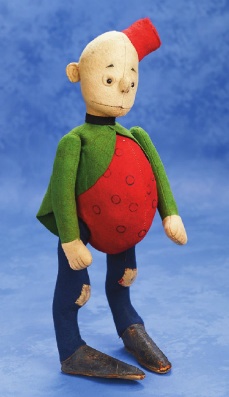
Let's move happily along to our third and final Steiff cartoon auction highlight. Here we have Steiff's Hoolygan or Happy Hooligan, produced from 1904 through 1927. He is lot #232 and is described as...
"14" (36 cm.) Firmly-stuffed felt character with egg-shaped head having center-seam, shoe-button eyes, caricature face, upturned nose, stitched-on ears, red attached cap, big plump red felt stomach with painted circle designs, green felt jointed arms and jacket, and long spindly jointed legs with patched knees and over-sized leather feet. Condition: good, some shelf dustiness, few moth holes. Comments: Steiff, from their premiere series of character dolls, representing the popular comic strip character of Happy Hooligan, circa 1910. Value Points: delightful character exactly captures the beloved figure from the comic series."
Steiffgal's happy to tell you more about this rare comic character. Happy, who is actually usually unhappy, was penned by popular and prolific writer Frederick Bur Opper and introduced in 1900. According to the artist, Happy is "a sad, smiling victim of wayward children and heartless adults... and a direct ancestor of (Charlie) Chaplin's "little man"." He and his two brothers, Montmorency and Gloomy Gus, were Irish tramps who traveled across Europe. They were sometimes joined by two Frenchmen named Alphonse and Gaston. Steiff produced a 35 cm version of Alphonse from 1904 through 1928 and a 50 cm version of Gaston from 1904 through 1927. Steiff records also show that these Frenchmen were also produced as pantom or marionette style puppets on roller skates. Like Foxy Grandpa, Happy Hooligan also had a press voice box hidden under his red felt hat.
Steiffgal hopes this review of Theriault's cartoon doll auction highlights has been as delightful as reading the Sunday newspaper comic section!
Have a question about one of your Steiff treasures? Let's talk! Click here to learn more.
![]() |
| Foxy Grandpa, lot #237 |
"14" (36 cm.) Felt swivel head with press-modeled facial features, pronounced nose, center seam, stitched ears, black shoe-button eyes on felt pads, mohair wig, attached hat, firm ball-shaped stomach with jointed arms and legs, shaped knees, over-sized feet, wearing original sewn-on blue wool costume. Condition: fair, some fading, few moth holes, wig very sparse. Comments: depicted is the comic character "Foxy Grandpa" from the early 20th century comic series, Steiff, circa 1910. Value Points: very rare early doll by the firm, he has an early Foxy Grandpa celluloid pin and a first prize award from a 1944 doll show."
![]() |
| Original Foxy Grandpa comic strip from 1905, click to enlarge |
![]() |
| Barney Google and Spark Plug, lot #235 |
"5" (13 cm.) 5"(13 cm.) Barney, 8"l. Spark Plug. The set comprises stockinette Barney with press-shaped and painted features, prominent nose, large felt eye whites with black bead eyes, whiskers, armature padded body, wearing original purple vest and blue jacket, shoes and hat, plaid cotton pants; along with Spark Plug, who has grey mohair coat with sparsely-inset yarn mane, bead eyes on felt pads, felt tongue and feet, harness, and yellow felt blanket with patches and printed Spark Plug name. Condition: generally excellent, bright fresh colors, few moth holes on blanket. Marks: Copyright 1923-1924 by King Features Synd, Inc. DeBeck (muslin pad on one foot) Steiff (silver button in ear). Comments: Steiff, Germany, the set was issued in 1925-1927 only, and according to company archives only 615 sets were sold. Value Points: very rare Steiff comic character set is well-preserved and delightful."
Here's more about this (sort of) dynamic duo. Barney Google, penned by artist Billy DeBeck, debuted in the Hearst Newspapers in 1919. Barney was a silly, bumbling little man who seemed to find even the simplest things complicated. In 1922, DeBeck gave Barney a new companion, a race horse named Spark Plug; a few years later they were joined by an ostrich named Rudy. Barney Google was so popular that he inspired the 1923 hit tune "Barney Google (with the Goo-Goo-Googly Eyes)," as well as the 1923 record, "Come On, Spark Plug!" You can listen to the song above by pressing on the white arrow in the middle of the record. In addition to this Barney/Spark Plug set, Steiff also produced several Barney Google themed pull toys on wooden during this same period. Rudy was made as a sample, but never put into widescale production.
And just how rare are Steiff Barney Google themed items? Steiff was asked to set up an exhibit of incredible rarities at the FAO Schwarz store in New York City in honor of the retailer's 150th anniversary in August, 2012. From the archives, Steiff sent over a Barney Google and Spark Plug on wheels - along with things like the earliest rod bear, an original hot water bottle Teddy, and a turn of last century tumbling bear. So even Steiff considers these characters quite legendary!
![]() |
| Happy Hooligan, lot #232 |
"14" (36 cm.) Firmly-stuffed felt character with egg-shaped head having center-seam, shoe-button eyes, caricature face, upturned nose, stitched-on ears, red attached cap, big plump red felt stomach with painted circle designs, green felt jointed arms and jacket, and long spindly jointed legs with patched knees and over-sized leather feet. Condition: good, some shelf dustiness, few moth holes. Comments: Steiff, from their premiere series of character dolls, representing the popular comic strip character of Happy Hooligan, circa 1910. Value Points: delightful character exactly captures the beloved figure from the comic series."
![]() |
| Original Happy Hooligan comic strip from 1904, click to enlarge |
Steiffgal hopes this review of Theriault's cartoon doll auction highlights has been as delightful as reading the Sunday newspaper comic section!
Have a question about one of your Steiff treasures? Let's talk! Click here to learn more.
Labels:
auction,
Barney Google,
cartoon,
comic,
doll,
felt,
Foxy,
Grandpa,
Happy Hooligan,
highlights,
Spark Plug,
Steiff,
Steiffgal,
Theriault's
Saturday, December 29, 2012
Living The Steiff Life On German Television
If you love something, why not share it with the world? Especially when it comes to Steiff! Over this past summer, Steiffgal had the once in a lifetime experience of working with a TV crew from Germany on a half-hour television documentary about Steiff collectors and the Steiff Summer Festival, which is held the first week in July every year. The program ran on German prime time television in mid-December.
You can click here to see the show. Perhaps you will recognize a face, or two, or three! Even if you do not speak German, it is quite entertaining. After all, the love of Steiff is a universal language we can all understand.
The documentary was produced by Petra Peters, a talented and experienced film maker. She and Steiffgal really hit it off, and Petra agreed to be interviewed about making the film. Come and learn a little about her, and what it takes to make a program which millions of viewers will see!
Steiffgal: Tell us a little bit about yourself: Your name, where you live, and your profession.
Petra: My name is Petra Peters. I am 44 years old and I live outside of Hamburg in the countyside of Northern Germany. I´m a film director and author and as for this I have been working for German Television for 20 years now.
Steiffgal: Are you interested in Steiff? If so, do you have a collection, and if you do, tell us a bit about your collection.
Petra: Actually I just have a few Steiff animals, which my parents gave me, when I was a child. And then I have this little, sweet pony, which you gave to me. After making this film, I am really considering to build up a collection step by step. I think it is such a nice hobby and passion.
Steiffgal: How did you come up with the idea of making a documentary about Steiff and Steiff collectors?
Petra: I read something in the Internet about the Summer Festival in Giengen. And then I searched online for further information and I found Carsten Eßer and his company Teddy Dorado. After a few interesting and funny talks on the telephone, I was sure, that this would be a beautiful great subject for a film. I thought, that there might be a lot of crazy, interesting, and passionate Collectors and Steiff Enthusiasts coming to Giengen in the summer. And this from all over the world and the Teddy bears connecting them all together. What a wonderful story!
Steiffgal: Who did you choose to feature in the film, and how and why did you choose those particular collectors?
Petra: First of all I connected Carsten Eßer. It was pretty clear soon, that he would take part in the film. He gave me several contacts to collectors in Germany. I choose the Eichel family, because they live with Steiff animals for more than three generations and they are completely crazy about Steiff. Furthermore they have a very exclusive collection at home. Then Carsten told me about you and your friends coming the long way from the USA to this year's Summer festival. What a gift and luck for the film, I thought. Carsten then recommended you to be a part in the film, as you have a very special collection, too, and your whole life is Steiff. And, you are of course an open-minded person and a real Steiff expert.
Steiffgal: How did you study or prepare for the filming and interviewing?
Petra: I read a lot and studied everything about Teddy bears and their collectors I could get. Internet, books, and so on. I visited the Eichels and also Carsten Eßer and we talked a lot. You and me, we talked on the phone and we Skyped.
Steiffgal: What were some of the surprising or unexpected things you saw or learned about Steiff during the filming process?
Petra: I was very surprised, that the worldwide connection really works out. You met so many friends on the festival – that was amazing. I think I never met such a lot of crazy, but very likable people in such a few days. We really had a great time. And we learned that collecting Steiff is a real passion and love.
Steiffgal: Looking back, what was your favorite moment overall during the Steiff filming process?
Petra: There were so many favorite moments, so many. For example: To see, how the Eichels live with their collection. Then, when your arrive and you meet Carsten for the first time. Or, when you meet your friends on the festival. And, of course Othello: A beautiful bear. And the auction was very exiting.
Steiffgal: How do you decide what ends up in the film and what ends up on the cutting room floor?
Petra: That was the most difficult thing. The film can not be longer than 30 minutes at the end. During the editing process we first had a version that took 90 (!!) minutes. So we had to shorten it more and more. I had to separate from good pictures – that wasn´t easy. At the end I decided for the almost best scenes and those which are important to tell the story.
Steiffgal: How long does it take to go from the raw footage to the finished project?
Petra: After the shooting I always have to watch picture by picture and make lists about the raw footage. That takes about three days. Then the editing and finishing (including speaker and voice over) takes about 10 more days.
Steiffgal: Petra, many thanks for your time. It was a pleasure to work with you on this project!
Steiffgal hopes this interview with Petra has made you feel like a TV star!
Have a question about one of your Steiff treasures? Let's talk! Click here to learn more.
You can click here to see the show. Perhaps you will recognize a face, or two, or three! Even if you do not speak German, it is quite entertaining. After all, the love of Steiff is a universal language we can all understand.
![]() |
| Petra Peters at the 2012 Steiff Auction |
Steiffgal: Tell us a little bit about yourself: Your name, where you live, and your profession.
Petra: My name is Petra Peters. I am 44 years old and I live outside of Hamburg in the countyside of Northern Germany. I´m a film director and author and as for this I have been working for German Television for 20 years now.
Steiffgal: Are you interested in Steiff? If so, do you have a collection, and if you do, tell us a bit about your collection.
Petra: Actually I just have a few Steiff animals, which my parents gave me, when I was a child. And then I have this little, sweet pony, which you gave to me. After making this film, I am really considering to build up a collection step by step. I think it is such a nice hobby and passion.
Steiffgal: How did you come up with the idea of making a documentary about Steiff and Steiff collectors?
Petra: I read something in the Internet about the Summer Festival in Giengen. And then I searched online for further information and I found Carsten Eßer and his company Teddy Dorado. After a few interesting and funny talks on the telephone, I was sure, that this would be a beautiful great subject for a film. I thought, that there might be a lot of crazy, interesting, and passionate Collectors and Steiff Enthusiasts coming to Giengen in the summer. And this from all over the world and the Teddy bears connecting them all together. What a wonderful story!
![]() |
| Filming in the Steiff Sales Tent During The Festival |
Petra: First of all I connected Carsten Eßer. It was pretty clear soon, that he would take part in the film. He gave me several contacts to collectors in Germany. I choose the Eichel family, because they live with Steiff animals for more than three generations and they are completely crazy about Steiff. Furthermore they have a very exclusive collection at home. Then Carsten told me about you and your friends coming the long way from the USA to this year's Summer festival. What a gift and luck for the film, I thought. Carsten then recommended you to be a part in the film, as you have a very special collection, too, and your whole life is Steiff. And, you are of course an open-minded person and a real Steiff expert.
Steiffgal: How did you study or prepare for the filming and interviewing?
Petra: I read a lot and studied everything about Teddy bears and their collectors I could get. Internet, books, and so on. I visited the Eichels and also Carsten Eßer and we talked a lot. You and me, we talked on the phone and we Skyped.
Steiffgal: What were some of the surprising or unexpected things you saw or learned about Steiff during the filming process?
Petra: I was very surprised, that the worldwide connection really works out. You met so many friends on the festival – that was amazing. I think I never met such a lot of crazy, but very likable people in such a few days. We really had a great time. And we learned that collecting Steiff is a real passion and love.
Steiffgal: Looking back, what was your favorite moment overall during the Steiff filming process?
Petra: There were so many favorite moments, so many. For example: To see, how the Eichels live with their collection. Then, when your arrive and you meet Carsten for the first time. Or, when you meet your friends on the festival. And, of course Othello: A beautiful bear. And the auction was very exiting.
Steiffgal: How do you decide what ends up in the film and what ends up on the cutting room floor?
Petra: That was the most difficult thing. The film can not be longer than 30 minutes at the end. During the editing process we first had a version that took 90 (!!) minutes. So we had to shorten it more and more. I had to separate from good pictures – that wasn´t easy. At the end I decided for the almost best scenes and those which are important to tell the story.
Steiffgal: How long does it take to go from the raw footage to the finished project?
Petra: After the shooting I always have to watch picture by picture and make lists about the raw footage. That takes about three days. Then the editing and finishing (including speaker and voice over) takes about 10 more days.
Steiffgal: Petra, many thanks for your time. It was a pleasure to work with you on this project!
Steiffgal hopes this interview with Petra has made you feel like a TV star!
Have a question about one of your Steiff treasures? Let's talk! Click here to learn more.
Labels:
Carsten Esser,
documentary,
Festival,
Giengen,
Petra Peters,
Steiff,
Steiffgal,
Steifflife,
Summer,
Teddy Dorado
Subscribe to:
Posts (Atom)