Sometimes just a little bit is more than enough! And that is the case when it comes to Steiff's delightful woolen miniatures. These petite and precious treasures, which are amazingly constructed and pack so much detail into so little space, have been collector's favorites since their introduction in 1931. Steiffgal recently welcomed several new, somewhat unusual wonderful woolies into her collection. Take a big look at these tiny treats - perhaps you'll fall in love with them, too!
Let's kick things off with this adorable "pet set." Here we have Steiff's woolen miniature guinea pig and hamster. Both are 6 cm, made from woolen yarn, with peach colored felt ears and double thick white felt front feet. Both the guinea pig and hamster have black button eyes and clear mono filament whiskers. The guinea pig is white, black, and orange while the hamster is golden yellow and white. They are basically the same design in different colors with one finishing difference: the hamster has a tiny white felt tail while the guinea pig is tail-less. Both these items never had chest tags. Guinea pig appeared in the line from 1973 through 1980 and hamster from 1973 through 1979; both were made in this size only.
This next woolie will certainly bug you, but that's ok in this case. Here we have Steiff's woolen cockchafer, also known as a may bug or beetle. He is 4 cm and made of brown, white, and black yarn. His underside and six legs are formed from a thin piece of brown dye-cut plastic. He has a tiny black woolen tail. His head most interestingly is made from a round black plastic bead, which is finished with two black string antennae. Cockchafer was manufactured from 1969 through 1974 in this size only; he is one of the very few Steiff items that never had a Steiff button or tag.
Here we have a very small bundle of joy. This lovely item is Steiff's woolen stork. She is 11 cm, standing, and made from pure white woolen yarn. Her tail feathers are scalloped and made from black felt, and her long legs and toe-d feet are red plastic. Her tiny face is detailed with black button eyes and an orange plastic beak - which would be perfect to hold a tiny new baby! Her neck contains a flexible metal wire so it is somewhat poseable. This item never had a chest tag as there was no place to put it. Stork was manufactured from 1970 through 1977 in this size only.
It's always fun to hang out with Steiff, and this last item really illustrates that point. Here we have Steiff's highly kinetic "Woolen Coral Reef Fish Mobile." The mobile consists of five little woolen miniature fish that are carefully balanced and weighted on tan strings and thin metal wires to create this hanging piece of art. The fish themselves are 7 cm each and made from colorful woolen yarns. Each has black plastic fins, large brown and black pupil eyes, and a large, smiling, felt mouth. The fish are primarily blue, yellow, green, orange, and red, and all have their button and yellow flag on their top fin area. This set appeared from 1969 through 1975 packaged in a square plastic box. This marvelous mobile hangs playfully from Steiffgal's dining room chandelier and is a constant source of food for thought - no pun intended!
Steiffgal hopes this discussion of unusual Steiff post war woolen miniatures has helped to brighten your day in a big way.
Have a question about one of your Steiff treasures? Let's talk! Click here to learn more.
Showing posts with label mobile. Show all posts
Sunday, November 17, 2013
Sunday, April 15, 2012
Golden Highlights From the April, 2012 Teddy Dorado Auction
Auctions can be a collector's best friend. Think about it... they are the perfect place to discover treasures, learn about new finds, meet friends and fellow enthusiasts, and sometimes even score a fantastic item at an unbelievable price. And in many cases, auction houses produce sale catalogs which can be a great reference for identification and valuation for future finds. For Steiff collectors in particular, such is the case for the upcoming April 28, 2012 Teddy Dorado auction. Although the physical event takes place in Germany, bids are welcome from all over the world! Here's a few precious items up for offer that really caught Steiffgal's eye... and why!
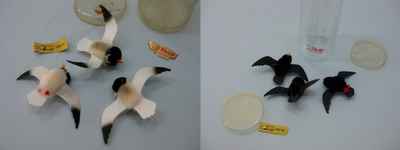
These first two finds make Steiffgal feel like floating on air! Here we have two marvelous Steiff mobiles, both from the 1974 through 1976 time period. The first is a seagull mobile (on the left), which consists of three miniature black,
white, and gray seagulls. Each 3 x 3 cm bird has a woolie pompom body and head, orange beak, red feet, and a felt tail and wings. The second is a raven mobile (on the right) which also consists of three tiny black birds. Each 3 x 3 cm raven has a black and blue woolie pompom body and head, an orange mouth, red feet, and black felt tail and wings.
Good things come in threes - and such are the similarities between these two unusual collectibles. First, it is interesting to note that in both cases, the only Steiff button and tag on the item is located at the top of the mobile; none of the animals have any specific Steiff branding on them at all. Secondly, the animals in both mobiles are modifications of standard line woolen miniatures with legs. Steiff has produced a standing woolie seagull and a raven, but neither has outspread wings. And finally, both models are packed in clear plastic tubes and have their animals suspended at different lengths from clear
nylon string. Due to their delicate construction and packaging, this makes both examples quite rare today.
This next lot really got Steiffgal's mouth watering! Here we have a collection of items from the Steiff cafeteria dating in the 1954 through 1964 period. The lot includes a white coffee cup, plate, and saucer; a teaspoon; blocks of sugar; and a server's pad to record a guest's order.
These items each have a tasty background to them. The cup and saucer were made by Bauscher Weiden, a well known German porcelain manufacturer that has been in business since 1881. The word "fabrikdekoriert" on the bottom of the cup, plate, and saucer means "factory decorated" and implys that these items were produced as a special order for the Steiff company. The spoon is marked with "Cromargan Germany", suggesting that it was made by the Wurttembergische Metallwarenfabrik or WMF company, a German company that can trace its origins to 1853. During the second half of the 20th century, this company focused its production on home and lifestyle products, including stainless flatware. The sugar cubes are wrapped in white paper and bear the Steiff logo in blue, and the words "Südzucker cube Raffinade" and/or " Hellma Ernst Zuckerwürfel Stuttgart" on the sides. "Zucker" means sugar, and "zuckerwürfel" means sugar cube, in German. The imprint probably is the name of the sugar cube manufacturer or supplier who was located in Stuttgart, which is located about 75 miles from Giegnen. (Part of Steiffgal's family from Stuttgart as well!) And finally, the server's pad hints that in 1954, in terms of beverages, the cafeteria was serving beer, lemonade, Coca Cola, milk, buttermilk, yogurt, cocoa, and chocolate milk, among other refreshments.
Of course, Steiffgal is very intrigued that "bier" or beer is the first option - and the list is clearly not in alphabetical order!!
This final Teddy Dorado auction highlight is just about purrr-fect in every way. Here we have Steiff's teeny-tiny 7 cm Fluffy cat from around 1927 through 1943. She is sitting, unjointed, and made in part from bluish tipped mohair, which is just spectacular. Her little tail wraps sweetly around her body. Fluffy's face is detailed with tiny deep green and black pupil eyes and a simple hand embroidered red nose and mouth.
The hugely popular Fluffy design was introduced in 1926. Her details are quite typical of other products Steiff created during "the roaring 20's" - items tended to have large, childlike eyes, bright colors, playful textures, and a distinctly feminine touch to them. Fluffy was such a favorite that she was produced in nine standard sizes, as well as on a pincushion, as a music box, and as a tail turns head model. She appeared in the line through 1950. Her design was slowly replaced by Susi, another favorite sitting style cat, who was a line standard through 1978.
Steiffgal hopes that this discussion on auction finds has you going once, going twice, going three times to discover the treasures that live sales events can offer.
Have a question about one of your Steiff treasures? Let's talk! Click here to learn more.
Subscribe to:
Posts (Atom)