Showing posts with label fuchs. Show all posts

Sunday, October 17, 2021

It's Easy To Outfox This Early Postwar Steiff Mystery!

Tag - you're it - when it comes to this week's Steiff inquiry. Check out this note from a new friend who has found a mystery fox. He seems Steiff-y... but was he indeed made by the Steiff factory in Germany? And when? She shares:

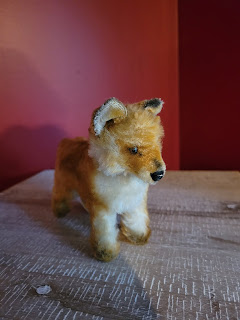
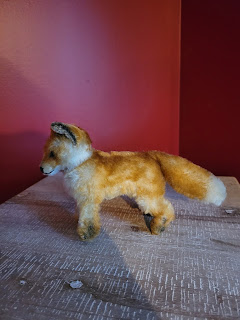
Hi - came across this little guy and thought he was cute - intrigued by the made in US Zone Germany tag located on the back of his right leg seam so I started researching and now I am wondering if he is vintage Steiff? He does not have a button or flag or anything identifying him as Steiff. He is approximately 6 inches from tail to end with another 3 inches for his tail. His head is articulated. He appears to be made of mohair and I am not sure what the filling is but it is very firm and stiff. Here are some pictures. Thank you!"

This sweet field and forest friend was indeed made by Steiff, and is one of the most beloved early post war designs amongst collectors today. This fox pattern is known for its great coloring, big fuzzy tail, and really appealing presentation. These foxes come to life with realistic airbrushed highlights on their feet, ears, and faces. Each is detailed with brown and black glass pupil eyes, a black hand embroidered nose and mouth, and a bit of pink airbrushing to on their lips. This legacy pattern was produced in 10, 14, and 17 cm from 1950-1957.  The smallest size is unjointed while the medium and larger sized ones are head jointed. The example under discussion today is most likely the medium or 14 cm version. 
Now let's get into the zone and talk about this fox's tag.
The US Zone tag on this fox is sort of a Steiff ID, but more a general indication of the time frame in which it was made. This is so because many German companies were required to note this production detail following the end of World War II. For example, 
Steiffgal has also noted similar text on items produced by Schuco - including white cloth tags on their soft plush toys as well as imprints on the chassis of their metal vehicles. White linen or ribbon tags were attached to all Steiff soft toy items from 1947 through 1953 (although Steiffgal has only personally seen them on items from 1951 onward.) These all read: Made in US - Zone Germany. Given this fox was in production from 1950-1957 and Steiff used these tags consistently from 1951-1953, it is safe to say that he was manufactured in the very early 1950s. 

The "US Zone Tag" has an interesting story behind it.  At the end of WWll, the Allied powers divided Germany west of the Oder-Neisse line into four areas: American, British, French, and Soviet occupational zones.The Americans were responsible for the southern part of Germany, which is where Steiff is located. The forces were tasked at "demilitarizing" Germany, which included shutting down many factories that did, or had the potential to produce items that could be used for combat or aggressive purposes. 

When Steiff's very limited postwar production slowly started up again in 1945 - 1946, items could only be sold to the American troops. These restrictions were gradually eased and by 1947 Steiff could sell domestically; by 1949 the company's products were once again available internationally. The "US Zone Tag" insured to the outside world that items produced in Germany were done so in a "civilian" factory and met business and distribution standards set up by the American military government overseeing the occupational zone. 

Steiffgal hopes this discussion on this mystery fox has been an engaging tail for you!

Have a question about one of your Steiff treasures? Let's talk! Click here to learn more.

Friday, January 22, 2016

Crazy Like A Fox Over This Early Postwar Steiff Find!

Are you crazy like a fox?  Hey, there's nothing wrong with that, if your nuttiness is all about Steiff!  Steiffgal definitely fits that description - perhaps you do as well?!  Some of Steiffgal's favorite Steiff animal designs are the company's great foxes produced over the years.  So she was over-the-moon excited to adopt a delightful vintage example from an antique show she recently attended in Florida.  Check out this great example and see what makes him such a field and forest find!

Here we have Steiff's early postwar Fuchs or Fox.  His official "size" is 14 cm, but he actually measures 13 cm tall and 16 cm long.  His hefty and impressive tail adds another 10 cm.  He is standing on all fours, head joined, and made from tan mohair that has been airbrushed with vibrant, copper colored highlights all over the top of his body and head.  He has black airbrushed paws as well as black highlights on his nose, eyes, and around the periphery of his ears.  The insides of his ears and his lips have very light pink airbrushed highlights.  His face comes to life with a slightly shorter mohair muzzle, brown and black glass pupil eyes, and a black hand embroidered nose and mouth.  He truly has a realistic, yet playful look about him.  This model was made officially in 10, 14, and 17 cm from 1949 through 1957 overall.  Unlike the 14 and 17 cm versions, the 10 cm version is unjointed.

Who knew foxes cleaned up so well?  Steiff, apparently... as the company also produced this beloved design as a boy and girl pair of well dressed, head jointed fox dolls.  This dynamic duo was made in 25 cm from 1950 through 1954 and dons traditional German outfits made from fine felt, calicoes, and other top-tier materials. Their stiff, standing bodies are made from linen. Steiffgal has the boy in her collection but has been on the hunt for his girlfriend for ages!  She purchased him at the 2010 Steiff auction at Christie's in London.  A bucket list experience indeed. You can see this lonely bachelor pictured here on the left.

One thing that makes the fox pattern under discussion today so special is its legacy.  It was actually also produced pre-war in a number of variations.  These included a wool plush version available with or without wheels in 14, 17, and 22 cm made from 1933 through 1939 overall; a sitting wool plush version in 14, 17, and 22 cm made from 1932 through 1937 overall; and a mohair version in 14 and 17 cm made from 1937 through 1943.  

This pre- and postwar spanning model fits within a very interest point in the design evolution of Steiff foxes.  Steiff debuted its first fox in 1897; this model was made from felt, standing, and on metal wheels.  It was produced in 22 cm through 1905.  Next came the company's first mohair foxes in 1909.  These had a distinctive "Teddy bear" like face, black mohair trim around their ears, and an eye-catching white mohair inset chest panel. These were made fully jointed, sitting, and on wheels through 1933.  A nice example of this design is pictured here on the left. The fox design under discussion here followed immediately on the heels of the company's earliest mohair models.  It shares many transitional aesthetic features, but in essence is a simplified model (less jointing, less complicated manufacturing and detailing) than its predecessor's design.  By 1960, Steiff had simplied its mohair fox even further, with the introduction of Xorry Fox in 11, 18, and 28 cm.  Xorry appeared in the line through 1969.

Steiffgal hopes this discussion on Steiff's pre- and post war fox design has been a smooth transition for you.

Have a question about one of your Steiff treasures? Let's talk! Click here to learn more.
The teddy bear search engine