Showing posts with label Albert Schlopsnies. Show all posts

Sunday, September 11, 2022

Fantastic Steiff "Firsts" On Offer Through Ladenburger Spielzeugauktion's September 24th, 2022 Event!

Love at first sight! That's the best way to describe some of the temptations coming up for sale at Ladenburger Spielzeugauktion's Fall event. This can't miss auction features 107 delightful vintage to antique Steiff selections and will be held on Saturday, September 24th, 2022. Here are three wah-hoo good treasures from this auction that Steiffgal has never seen come up for sale before. Enjoy this "one-derful" eye candy!

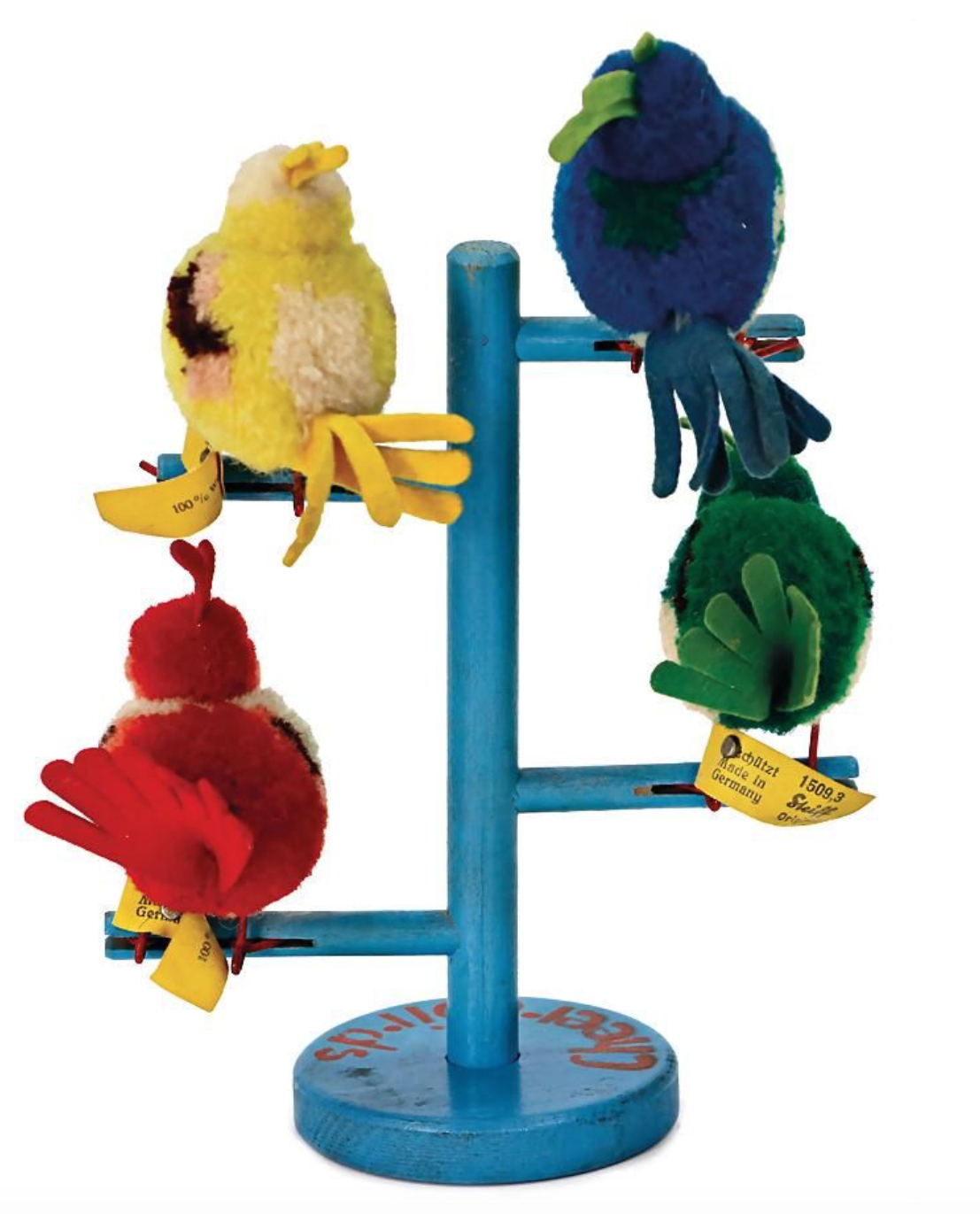
Bird's the word when it comes to this first auction debut item highlight. It is lot #3097, a most unusual woolen miniature bird display, estimated at 220-440 euros. It is cataloged in part as:

"Cheerubirds, rare bird tree, 4 x paradise birds, 100 % wool, with rare original breast sign, Blue Bird No. 1509,2, St. Patrick Bird No. 1509,3, Birthday Bird No. 1509,1, St. Valentine Bird, No. 1509,4, 22 cm, probably special design for the American market, extremely rare, unusual."

Who wouldn't love to feather their nest with this fantastic display? According to the Sortiment, this item appeared in the line from 1953-1956 with its own article number of 5204 Ch. Its overall design gives off a great midcentury vibe. But what makes this rarity so special - in addition to its amazing condition - is that each of the birds not only has a chest tag, but a very custom one. Steiffgal cannot think of any other woolen minis that have chest tags, probably due to their construction and size. The birds featured on this display are otherwise standard line "woolen exotic birds" which appeared in the line from 1953-1966; the earliest ones had red metal feet and legs and those from 1956 onward had plastic feet and legs. 

Now let's take a tumble for this next auction debut highlight. This is lot #3073, a felt, fully jointed circus performer doll, estimated at 280-560 euro. It is cataloged in part as:

"Acrobat, produced between 1911-1918, felt, jointed, from the circus series, with button, block letters, long trailing f, blue glass eyes original clothes, 40 cm, felt is a bit darken, small felt faults at 1 hand, and at stomach and at 1 shoulder, otherwise nice condition, exceptional, rare."

This fine, flexible fellow is a wonderful and seldom seen acrobat doll from Steiff's legacy "Schlopsnies Circus" display. This large scale, dynamic, and extremely popular exhibit was designed and created by Steiff doll freelancer Albert Schlopsnies in the c. 1910-1920 time frame. It consisted of over 30 circus themed dolls and acrobats, based on real life performers at the world famous Circus Sarrasani of Dresden, Germany. The acrobat dolls were often posed in death-defying or upside down poses in the displays. Sometimes they were even animated via camouflaged mechanisms. Steiffgal has seen or handled several of this acrobat's colleagues, including clowns, stagehands, and other performers, but she has never seen or handled this acrobat before. 

And last but hardly least, this final debut auction highlight just begs for attention. Here we have lot #3069, a charming prewar canine themed display, estimated at 280-560 euro. It is cataloged in part as:

"Exceptional show piece, Waldi, on a mohair plate, plate partially with a bit mohair loss, height: 30, width: 30 cm, depth: 22 cm, attending, with huntsman's hat, with button, chest label and a  very beautiful preserved red cloth tag label, with No. 4328,2, probably 1930, nice full mohair, breast sign is a bit faded, with small Treff, sitting, 14 cm, swivel head, exceptional, extremely rare."

This probably one of a kind treasure stands and delivers. It features one of Steiff's most beloved and prolific dog designs, Waldi the Dachshund. Waldi is most often on all fours. However, from 1933-1936, he was produced in a begging position in 17, 22, and 28 cm. His red ear tag numbers perfectly corresponds to that, with 4= begging or standing on back legs, 3= mohair, 28=28 cm tall, and ,2=with a voice. So the dog in itself is a total rarity! The fact that he is mounted on a factory original green mohair mat (probably to resemble grass), wears a  typical German style hat, and is accompanied by a perfectly paired and period Treff friend, make him over the top interesting. 

How this rare pair came to be remains a mystery, though. This charming display could have been produced as part of a larger exhibit, assembled by employees and presented to their friend or colleague as a special tribute gift, or perhaps made as a whimsy, end of day, or prototype that never went into production. Only Waldi and Treff know for sure!


Steiffgal hopes this discussion on these debut Steiff auction treasures has been like an opening night celebration for you. 


For more information about Ladenburger Spielzeugauktion upcoming Steiff event on September 24th, please click here!


Have a question about one of your Steiff treasures? Let's talk! Click here to learn more!

Saturday, March 17, 2018

Go To The Head of The Class With This Amazing Steiff Student Doll

Can you teach an old dog new tricks? Well, when it comes to Steiff, there is always something new to learn, no matter how old you are - or how many years you've been studying all things button-in-ear! Such is the case with this marvelous and extraordinarily rare black doll, best known through a Steiff schoolroom display from the turn of last century. (But more about that in a bit!) This "head of the class" little fellow belongs to a dear friend of Steiffgal. And boy does she have a schoolgirl crush on him indeed! Come see what makes him so interesting from the design and historical perspectives.

This delightful doll is cataloged as "Negro Boy" in the Steiff literature. He is 35 cm, standing, fully jointed - including special knee joints - and made from light brown felt. These knee joints allow him to sit easily and comfortably. He has the typical Steiff vertical facial seam and a quilted, set-in mouth and red painted lips. He comes to life with very unusual tri-colored, almond shaped glass eyes, prominent and dimensional ears, and distinctive hair made from black curled wool material. His outfit, which is correct in design but not original to him, consists of a striped shirt, red vest, and plaid pants. Unlike many of the Steiff dolls of his time, this pattern is purposely barefoot. He was produced in this size only from 1912 through 1918.

Now for a little history lesson on him. This boy was produced at a key time in the company's doll history. Starting in 1911, the company began manufacturing dolls representing different far away countries and dressing them accordingly. They were referred to as "nation types." These included a Mexican cowboy, a Sinhalese girl from Sri Lanka, and a man and a woman from Argentina, among several others. These were all idealized as well as stereotypical in design, with exaggerated facial features and detailing, dramatic skin tones, and perfectly-to-scale national outfits. It is very possible that this line was designed by Albert Schlopsnies, Steiff's creative consultant who was hired to help grow the company's doll line and marketshare starting around 1910.

Prior to Steiff's nation types doll series, Steiff did make dolls in local attire (like their series of German farmers starting in 1908) as well as dolls dressed in regional outfits (like their Dutch children also starting in 1908.) However, unlike the nation type dolls that had specific ethnic features, coloration, and distinctive outfits, the dolls in local attire or regional outfits were standard line dolls dressed in outfits that were slightly modified in shape, form, or proportion - not entirely new patterns.  The Dutch girl, Alida, is shown here on the left. She was She was made from 1909 through 1919 in 28, 35, 43, and 50 cm.  She is described as "felt, jointed, Dutchwoman, original costume, Sunday best." "Sunday best" most likely meant she was wearing special or more upscale clothing for church - not an everyday outfit.

It's a clothes-call when it comes to Negro Boy's outfit. It is based on the clothing worn by schoolboys in a c. 1911 display. A photo of this display appears above, the picture is from the Cieslik's Button in Ear The History of the Teddy Bear and His Friends. In the photo you can see a black teacher giving a multiplication lesson to a classroom of black schoolboys. In the front rows are boys in yellow vests and red and white striped shirts; behind them are boys in orange vests and green and white striped shirts. Perhaps these different "uniforms" reflect the the boys' ages or grades. This one room school display is almost identical in theme to the company's one room school display featuring white children. You can read more about that display here.

Steiffgal hopes this discussion on this adorable Steiff schoolboy has you feeling like a genius!


Have a question about one of your Steiff treasures? Let's talk! Click here to learn more.

Sunday, May 1, 2016

Steiffgal's Quite Keen On This Steiff-Man Named Green!

Ever felt like running away and joining the circus? Well, this inquiry from a new friend in Europe about a fantastic Steiff entertainer may just have you packing your bags! Check out Åslaug's great family heirloom, a rare Steiff doll. She shares over a number of correspondences....

"Hello,

Do you know what the name/number of this Steiff-man is?

My mother in law was the owner of this. She collected a lot of things. Kind of a hoarder. She passed away in January. Among the things she has left behind is more than 1,000 dolls. Mostly bought at flea markets. Most of all she was interested in the culture and specially toys of her childhood.

A lot of her collected items has been given away to different collections and museums. But, this doll I fell in love with and we are intending to keep it. We also found 15 Steiff animals. Have sold seven, but have some still.

Kind regards and thank you from Norway"

No clowning around... this is one find that belongs in the spotlight! What Åslaug has here is a Steiff doll named "Green," probably because of the color of his eye-catching coat. Green is 43 cm tall and fully jointed. In addition to his gold and button trimmed outerwear, he wears a yellow felt vest, black felt pants, and Victorian looking, buttoned up "spat" style footwear. His face and head comes to life with black shoebuton eyes, a hand painted mouth, rosy cheeks, and a shock of handsome silver-grey hair. Green appeared in the line from 1911 through 1919. His series number is 88 (indicating that his pattern is a doll) and his article number is 43, meaning in this case that he stands 43 cm tall. A picture of Green as he appeared as new is pictured here on the left, the photo is from Pfeiffer's 1892-1943 Sortiment. 

Green was produced as one of many characters performing in a charming series of circus themed window displays.  Green is cataloged as a "lackey," which probably means he would have acted as a footman or assistant to other performers or to the circus managers.  Steiff's circus displays were created by Steiff creative freelancer Albert Schlopsnies starting in 1910. The first Steiff circus display made its debut at the Wertheim Department Store in Berlin. According to Cieslik's Button In Ear The History of the Teddy Bear And His Friends, "It had three circus-rings and visitors to the Steiff show were given a circus program - a comic adaptation of an actual program." (A copy of this program is to the left; if you click on it you can read the most entertaining text. The photo is from Cieslik.) Over the next decade, about 30 authentic character dolls including clowns, ringmasters, acrobats, musicians, and other performers were produced - in addition to stables of circus performing animals. Many characters were based on real life circus professionals at the time. 

Steiffgal hopes this discussion on Steiff's turn-of-last century circus performers and displays has been the greatest show on Earth for you.

Have a question about one of your Steiff treasures? Let's talk! Click here to learn more.
The teddy bear search engine