There's alot of love going around Steiffgal's home lately as she and Steiffguy (yes, there is a Steiffguy) are celebrating their 20th wedding anniversary this week. In Steiffgal's world, love is synonymous with dogs, as 'gal and 'guy share their roof with three of them!
To share the loving feeling, here is a kennel of outstanding vintage Steiff bulldogs that Steiffgal has totally fallen in love with (oops... she means has seen sell recently at auction.) These three models are such great examples of Steiff's creativity, quality and humor. Just take a look at these blue ribbon bow-WOWS...! First is this tiny cream and orange velvet Bully. This colorful canine is 10 cm, has a swivel head, big brown glass pupil eyes, and retains both his Steiff "ff" button and his metal-framed chest tag. This particular Bully model was produced from 1927 through 1935 and came in four sizes (7, 10, 14, and 17 cm) and three colors (black and white, blue and white, and orange and white). This design was very popular and was also produced in mohair around the same time. This precious puppy received 16 bids and sold for $721.00.
 The next featured bulldog is a truly remarkable "tail turns head" model. This 23 cm Bully is somewhat lifelike looking, is made from tan colored mohair, and has a very sweet felt lined open mouth. (Steiffgal recognizes this endearing "feed me" expression from real life experience!) He features a working "tail turns head" mechanism, which was quite a technical advancement in the toy world at the beginning of last century! This Bully was produced from 1931 through 1935 and came in six sizes: 11, 15, 18, 23, 26, and 31 cm. This mechanical Bully received 9 bids and sold for $683.55.
  Finally, this baroque Bulldog is almost as rare as the breed in real life! This proud pup stands 18 cm tall, is made from tan mohair which has been detailed with black airbrushing, has a swivel head, googly eyes, and an open pink felt lined mouth with two "canine" teeth. He sports a horsehair ruff, a "high society" accessory with origins in Elizabethan times. This highly sought after Steiff collectible is a US exclusive and was produced from 1956 through 1961 only. He received 26 bids and sold for $455.00.They say that dogs are a (wo)man's best friend. I would tend to disagree, and nominate Steiffguy for this title, at least this week! Thank you for the 20 years (or 140 in dog years) of love and friendship and here's to the next 20, and the next 20, and 20 more after that... Have a question about one of your Steiff treasures? Let's talk! Click here to learn more.
Steiffgal certainly loves detective work, so she was delighted to receive this question about a vintage family heirloom from a reader. This Teddy on-the-go is somewhat "Steiff-y" but not entirely. Read the clues... what do you think? Lilly from Michigan writes:
"Any help you could give me on this bear would be greatly appreciated. My mother was born in Stuttgart in the 1950's and believes this bear was either bought for her in the late 50's or my grandmother bought it for me in the 80's. She had quite a few Steiff animals but doesn't recall much about this one. He looks to be in pretty good condition for being 30-50 years old :)...the bear does not have a Steiff chest tag, button, and/or eartag but the red string that used to hold a tag is still there. He is 18 inches tall and about 2 feet long from nose to tail. He is not plush. He's pretty solid feeling, and one of his wheels is no longer attached and missing what I would call the hub cap.
Thank you!"Steiffgal is is 100% sure about one thing and 90% sure about another in reference to your question.
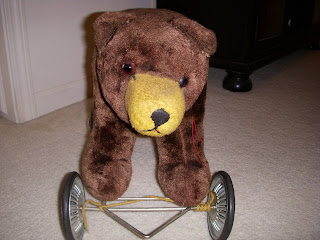 First, she is 100% sure that this bear is not a Steiff product. The body shape, facial details, and carriage structure are not of Steiff design and configuration.
Now to the 90% sure stuff. After much research and comparison, Steiffgal is pretty confident that your riding bear was made by another German company called Hermann. (Hermann is a multi-branched family company and has been in business for over 100 years. They make wonderful toys and highly prized collector's products. The history of the company is complicated and very interesting!) Your bear's face, with his prominent muzzle and "pouty" shaped stitched mouth, is typical to "traditional" vintage Hermann Teddy designs.
Additionally, you mention a red tag string. Hermann was known for attaching its labels and ID to its products via a red string. In general, Steiff attaches its chest tags to its products via a few neutral color stitches or a clear plastic staple.
 Steiff did make a reitbaer, or Riding Bear, from 1966 through 1983 that distantly resembles your possibly Hermann bear in size and assembly. Check out the picture of this bear on the right. Competing toymakers tend to create similar designs in tandem. Thus, it's Steiffgal's best guess that your Teddy is from around the same time period as this reitbaer. More specifically, she feels that your bear is more likely from the 80's than from the 50's. At least with Steiff, larger ride-on items from the 80's tend to have more "modern" metallic wheels while those from the 1950's usually sport wooden wheels. Lilly, Steiffgal hope that this detective work unravels some of the mystery behind your great family treasure!Have a question about one of your Steiff treasures? Let's talk! Click here to learn more.
Hello, hallo, bonjour, and こんにちは! Here is an article that Steiffgal wrote for the wonderful magazine Teddy Bear and Friends that was published awhile back. Do you recognize any of these national and international visitors....?Lost in TranslationSteiff’s legacy has always been the design and manufacture of beautiful, high quality Teddies and realistic looking animals. Across the world, families have cherished Steiff bears, dogs, bunnies, and other treasures; often handing them down from generation to generation as an integral part of their living history.
 In addition to these traditional play toys, Steiff also has a long history of creating promotional and commercial items. In the early 1900’s, Steiff began partnering with manufacturers and well known brands to create their logos, characters, and trademarks as Steiff products. For example, in 1913, Steiff was asked to create “Bibendum” out of felt in two sizes for a company in France. “Bibendum”, or “Bib”, is the Michelin Tire Man! The 1930’s marked the beginning of a long and still enduring relationship between Steiff and The Walt Disney Company. The wonderful velvet Mickey and Minnie Mouse dolls created between 1931-1936 are among the most precious and sought after finds for both Steiff and Disneyana collectors! Fast forward two decades to the 1950’s, and Steiff was producing the mascots for many German companies in the footwear, pharmaceutical, food, and publishing industries, among others.
Today, Steiff continues its nearly century long tradition of making commercial-themed products for some well known (and some not so well known) businesses, primarily across Europe. Many of these Steiff items are unfamiliar and perhaps even a little strange to Americans as the brands, companies, or organizations behind their inspiration are not available in the United States. So, let’s get “lost in translation” and take a look at some unusual new and older Steiff commercial collaborations and the stories behind them.
Tik i-Niki
Blink, and you would have missed him. With a face only a mother could love, Tiki-Niki was only manufactured in 1973. This humanized hedgehog is 30cm tall, has a hard stuffed torso; plastic head, hands, and feet; and wears a light blue jumpsuit. What is most distinguishing about Tiki-Niki is everything from the neck up: his little buck teeth, snout-nose, huge pupil-less cobalt blue eyes, and shock of long brown dralon hair.
So who is this odd little guy? Hedgehog Tiki-Niki is the creation of Denys Watkins Pitchford, a prolific English author also known by the pseudonym “BB”. Pitchford had a great love of the outdoors and wrote close to 60 books about nature over his lifetime. Nine of these books were written as children’s novellas, featuring Tiki-Niki and his best friend, Bill Badger, in a series of challenges and adventures. A Swiss TV network created a television series for children based on these beloved stories in the early 1970’s. Steiff’s Tiki-Niki quickly followed.
Goldi and Hor niGood things do come in twos. Goldi the Hamster and Horni The Traffic Squirrel are both free standing, 32cm tall, made from plush, and were made from 1978-1980. Goldi is one well dressed rodent, wearing both a bright yellow cotton jumpsuit with a red track suit over it. Both are emblazoned with his name. Horni wears monogrammed red cotton overalls, a white tee-shirt, and an orange felt cap. So what ties these two together forever (at least in the minds of many nostalgic young German adults)?
 One word: Commerzbank. One of Europe’s largest banks, Commerzbank was one of the early sponsors of Germany’s “Kinder-Verkehrs-Club” or “Children’s Traffic Club”. This countrywide program was launched in 1976 and ran until 1997. The goal of the program was to help parents of three to six year old children teach their youngsters about road and traffic safety. Goldi and Horni were both mascots of this program. Horni wears a Commerzbank plastic pin which shows he and Goldi arm in arm, encircled by the Traffic Club logofont.
Interestingly, Goldi has the Commerzbank logo on the underside of his Steiff ear tag, while Horni has the words Kinder-Verkehrs-Club on his. It was, and still is, quite unusual for Steiff ear tags to have anything but Steiff information or markings on them.
Loriot  Pull up a seat and take a look at this unusual piece. Yes, it’s a man in a mohair bear suit, chilling out on a red velour couch. Loriot is a 2003 white tag limited edition produced in cooperation with ars mundi, a leading mail-order art specialty catalog company from Germany. Loriot is floppy, stands 39cm tall, has a cloth face, feet, and hands, and wears a long curly brown mohair bear suit with a removable hood. Both Loriot’s “real” ear and Teddy mask ear have a Steiff “button in ear”. Loriot’s “throne” is built for a king and features gold tassels on the armrests.
 Although not a familiar personality in the U.S., Bernhard Victor Christoph Carl von Bülow, or “Loriot” is a beloved German writer, illustrator, comedian, and performer. An all around artist, he is best known for his cartoons as well as his TV performances, which have a “Monty Python” goofiness to them. This man-bear Loriot is strikingly similar to Loriot’s cartoon figures, with the men all having a soft fleshy face and a large bulbous nose. Interestingly, the “real” Loriot and Steiff go back over 40 years. Loriot was the artist behind Reinhold das Nashorn, (Reinhold the Rhino) a popular book and character created in 1954. Steiff created a mohair Reinhold for one year only in 1964. Reinhold remains one of the most sought after Steiff collectibles from that period.
Little Hung er
er
Please meet “Little Hunger” and feel free to shake his hand… his “spots” are not contagious! This 31cm unjointed white plush character certainly is a looker! He is covered in quarter-sized primary color dots. Little Hunger has a crooked and impish smile, large cloth hands and feet, plastic eyes, and a sprout of black “Mohawk style” hair.
Little Hunger is the mascot for a line of single serving sized rice pudding snacks produced by a German dairy company called Muellers. This animated character is well known across Germany and is often seen in funny and entertaining television commercials. And his dots? They match the hues of the lids of his product line. Steiff produced Little Hunger as a white tag limited edition of 5,000 in 2000.
Alpirsb acher Monks
So let’s end this tour of Steiff commercial oddities on a high note. And there’s no better way to do that then with a beer. Or how about almost a thousand years worth of beer? These two fun loving, trevira velvet “bier monks” are dressed in traditional garb including cotton drawers, long red hooded tunics, and work aprons which are cinched at the waist with a thin rope. The large monk, a whopping 100cm, has black felt feet, while the smaller 35cm monk wears tiny leather sandals.
These two monks are characters from the Alpirsbacher Klosterbraeu, a 130+ year old brewery located in Germany’s Black Forest. The monk’s brewery is housed in a former monastery which dates from the year 1095. Steiff created these white tag, limited edition drinking buddies in 1999. Just a handful of the 100cm monks were produced, primarily for display and advertising purposes. The smaller version was produced in an edition size of 1,500.
Each of the Steiff monks has the Alpirsbacher Klosterbrau logo proudly emblazoned on his apron—a smiling monk holding both a pitcher of beer and a traditional lidded beer stein. And why do monks and beer seem to go hand in hand in so many cultures? Monks originally perfected the art of brewing as a way to produce a filling and good tasting beverage to complement their often Spartan meals, especially those around fasting occasions.
Hopefully this tour has whetted your appetite for Steiff and the company’s range of commercial collectibles. Steiff has been integral to the German identity for over 100 years. So in turn, it is not surprising to see German cultural icons and logos manifest themselves through the Steiff product line over the years. If you do find an offbeat Steiff item—dig around a little and find out the true story behind it. You may discover that its background is just as fascinating as the piece itself!Have a question about one of your Steiff treasures? Let's talk! Click here to learn more.
Steiffgal has seen alot of Steiff, but nothing quite like this "blue ribbon" buddy sent in from a curious reader. After much "digging and sniffing" around for what seemed like dog years, she finally figured out who he is and the remarkable story behind him. Take a look at this note from Marvin, who writes from Texas:  "I have spent a lot of time from past to present trying to learn more about a family piece I own. I have an obviously, very rare, Steiff puppy or dog tail-turns-head dating Ca. 1920's-30's.
Like many of the early Steiff pieces that were made and sold in Germany, this is impossible to find anywhere! From what I know, this dog was not an import or mass-produced Steiff. What is also unusual is the open mouth. I will now provide all of the information you requested at your website/blog.
- Age: (eartag) According to the 8mm iron nickel plated button with f drawn back to E, this piece dates to 1925-1934; also has Steiff button tags on leather collar.
- The size of this dog measures 13" long excluding the tail. The full (L shaped) tail measures about 8". There is a thin metal rod that runs through center for turning.
- The dog is made of mohair and is oatmeal-like in color. It could be a golden retriever puppy like Marley from "Marley & Me".
- The eyes are glass. Brown with black pupils. Each eye measures about 11mm in diameter. The nose and claws are both stitched and black in color. ...he has an open mouth with pink felt lining.
- This Steiff dog is stuffed with straw.
- The tail and both front legs have a thin metal rod than runs through the center of them. The front legs have the same connected rod running through both of them, so that they will move at the same time if you move one of the legs. Probably U shaped iron rod connecting both front legs. The front legs are not jointed, neither are the hind legs either. This puppy dog may have originally stood taller on its front legs, in the front. It may need a little adjusting of iron rod in legs or just to have the seam re-sewn and positioned. This is a tail-turns-head dog, so it has a mechanical turning mechanism on its rear end.
 This puppy dog was brought to the U.S. by German immigrants. I have never seen another like it anywhere! I tried to do my homework to assist you by saving time, but I have reached as far as I can go! I am sure this will be interesting for you and your friends! My last word is HELP!!!!!!!!!!"
Hi Marvin; Steiffgal would be more than happy to help out here! What you have here is truly a remarkable piece, both for what it is and the story behind it.
 First the piece itself; Steiff calls your item Chinook Byrds Arctic Expedition Dog. The picture here on the left shows what he looked like brand new. Chinook is sitting (your piece got a little "bent out of shape" over time); made from cream colored wool plush that is airbrushed with light brown and black detailing; has an open pink lined felt mouth, brown glass pupil eyes, black stitched nose and claws; and sports a leather color. As you note, he features a tail-turns-head mechanism. Steiff manufactured this particular model of Chinook in three sizes: 23, 29, and 35 cm in 1931 and 1932 only.
 In addition to this sitting heads-turns-tail Chinook, Steiff also made three additional Chinook models in the 1930 through 1932 timeframe. These included standing (17, 28, and 43 cm), lying down (22, 32, 35, and 50 cm), and just sitting (22, 28, and 35 cm) versions. All have the same general look and sport elaborate leather collars studded with Steiff "ff" style buttons; only the two sitting up models have open mouths.
 So what's a Chinook, and what does it have to do with Byrd's Antarctic Expedition? A Chinook is a relatively recent breed of dog that was created by Arthur Walden of Wonalancet, New Hampshire in 1917 as a working dog. This breed was carefully and strategically derived from crossbreeding dogs from the Peary North Pole Expedition with other breeds with great stamina, strength, and cold weather tolerance.
Walden was an experienced dog driver with years of experience in the Yukon. For that reason was selected as the lead driver and trainer on the 1929 Byrd expedition, even though he was close to 60 at the time! Walden brought along his original Chinook, now 12 years old, and fifteen of his dog sons to provide surface transportation on the Antarctic ice for this critical exploratory mission.
Of Chinook, Byrd wrote: "...there was no doubting the fact that he was a great dog. ...Walden used him as kind of a "shock troop", throwing him into harness when the going turned very hard. Then the gallant heart of the old dog would rise above the years and pull with the glorious strength of a three-year-old."On the night of January 17, 1929, after an especially hard day of work, old Chinook wandered away from the base camp and was never seen again. Walden and the entire team were devastated; a highway in New Hampshire is named the Chinook Trail in honor of this dog and his heroic contributions. And what does this mean in terms of Steiff? It is not uncommon since the turn of last century for Steiff to use "celebrities" as inspiration for new products. The world was in love with Chinook; why not make him as a plaything? The precedent had already been set with a series of delightful and popular dolls and toys honoring Peary's North Pole Expedition in the 1908 - 1919 time frame.Marvin, Steiffgal hopes this information is helpful and gives you some background on your exceptional family treasure. Like the original Chinook, your collectible is simply Top Dog!Have a question about one of your Steiff treasures? Let's talk! Click here to learn more.



 Posts
Posts


 There's alot of love going around Steiffgal's home lately as she and Steiffguy (yes, there is a Steiffguy) are celebrating their 20th wedding anniversary this week. In Steiffgal's world, love is synonymous with dogs, as 'gal and 'guy share their roof with three of them!
 First is this tiny cream and orange velvet Bully. This colorful canine is 10 cm, has a swivel head, big brown glass pupil eyes, and retains both his Steiff "ff" button and his metal-framed chest tag. This particular Bully model was produced from 1927 through 1935 and came in four sizes (7, 10, 14, and 17 cm) and three colors (black and white, blue and white, and orange and white). This design was very popular and was also produced in mohair around the same time. This precious puppy received 16 bids and sold for $721.00.
 The next featured bulldog is a truly remarkable "tail turns head" model. This 23 cm Bully is somewhat lifelike looking, is made from tan colored mohair, and has a very sweet felt lined open mouth. (Steiffgal recognizes this endearing "feed me" expression from real life experience!) He features a working "tail turns head" mechanism, which was quite a technical advancement in the toy world at the beginning of last century! This Bully was produced from 1931 through 1935 and came in six sizes: 11, 15, 18, 23, 26, and 31 cm. This mechanical Bully received 9 bids and sold for $683.55.
  Finally, this baroque Bulldog is almost as rare as the breed in real life! This proud pup stands 18 cm tall, is made from tan mohair which has been detailed with black airbrushing, has a swivel head, googly eyes, and an open pink felt lined mouth with two "canine" teeth. He sports a horsehair ruff, a "high society" accessory with origins in Elizabethan times. This highly sought after Steiff collectible is a US exclusive and was produced from 1956 through 1961 only. He received 26 bids and sold for $455.00.