Friday, October 29, 2010

Monkeying Around With Steiff's Playful Primates

As most readers know by now, Steiffgal is absolutely ape over Steiff monkeys in all their various shapes and sizes.  So it is no surprise she went a little bananas about trying to help a reader with a question about a very interesting European monkey pair.  Take a look at this note from Beth, who wants to learn more about a delightful piece of her family's history.

"Dear Steiffgal:

I'm hoping you might be able to help me identify a vintage Steiff monkey toy.  I found this toy in a trunk that was filled with my Grandfather's WWII memorabilia.  No one in my family knows where it came from.

This is a plush toy which looks almost like an orangutan. It has a strange wrinkly face, which doesn't look like the Steiff "Jocko" dolls I've seen online.  

It's 19" long, with a tail, a zipper up the back and a baby monkey inside.  He appears to be made from a soft type of brown fur or material.

The baby monkey mohair and is in excellent condition.  He has a small Steiff button in its left ear.

Any help would be greatly appreciated.

Best, Beth"

Let's not monkey around and get started on this really interesting inquiry right away!  

First, the easy part of the question... without a doubt, the little guy is a Steiff Jocko.  This monkey pattern has been around basically with a few modifications since 1909.  And what makes a Steiff Jocko, well, a Steiff Jocko? Regardless of size, Jockos have "natural" body proportions and detailed felt hands, feet, and facial features. One key design element on larger models (25 cm and over) is the inclusion of felt eye pockets, meaning that the chimp's eyes are surrounded by raised felt eyelids; not simply sewn onto his face. Additionally, larger sized chimps also sport a white mohair chin. Prewar, Jocko was produced in 15 sizes, ranging from 10 to 90 cm, at various times from 1909 through 1943. It was in 1929 that this ace ape was finally given his “official” Steiff name, Jocko. Post war, Jocko was one of the very first items produced.  He appeared in the line continuously again from 1948 through 1990 in 9 sizes, ranging from 10 through 80 cm.  It appears that Beth's little Jocko monkey is most likely the 15 cm size. 

Now for the big one - and there's no need to sleep on its identification challenge!  Steiff did not make this slumbering sweetheart.  He was actually produced in the UK by an English manufacturer called Merrythought.  This is Merrythought's "Sleeping Beauty" nightdress case, which is basically a child's pajama bag.  The middle portion of the ape's torso is hollow and finished with a silk lining; this pocket closes with a zipper. Its design was based on the illustrations of Lawson Wood, a popular artist of the time.  A sample of Mr. Wood's monkey-themed illustrations is pictured here to the left.

This nightdress bag was produced from 1935 through 1959, which aligns quite well with the timeline Beth provides concerning the history of this family treasure.  The picture here on the left, from a wonderful book entitled "The Magic of Merrythought", shows Sleeping Beauty as she originally appeared in the company's product catalog. Steiff also made a number of PJ bags from the early 1930's onward, but never a Jocko as far as Steiffgal can tell.  Click here to read more about Steiff pajama bags over the years. Perchance, do any readers know of a Steiff Jocko pajama bag or have one in their collection?  Please let Steiffgal know if you do!

Steiffgal hopes this discussion of these charming chimps has been more fun than a day at the circus for you.

Have a question about one of your Steiff treasures? Let's talk! Click here to learn more.

Saturday, October 23, 2010

All Ears About This Beautiful Vintage Steiff Bunny!

Steiffgal is all ears when it comes to hearing about collector's favorite Steiff treasures.  So of course her attention turned "quick as a bunny" to this note she recently received from a reader about her beloved rabbit.  Suzanne from California writes:
 
"Hi Steiff Gal,
 
Attached is a photo of my "Manni Rabbit." She is straw stuffed, 23 inches tall, has an underscored button with remnants of a red tag under it. It looks orange in picture but it is red. Have you seen one like her? I would love any info you can come up with!
 
She was bought in Maine by someone at a doll auction and I bought her from them. I think she is so awesome and very old; she seems to have alot of mohair loss. She is my pride and joy.  Thanks so much for your wonderful website and I hope to hear from you soon.
 
Best,
Suzanne"
  
Let's hop right into a discussion on this beautiful bunny!  What Suzanne has here is Steiff's Hase or Rabbit.  This particular Hase model (For better or worse, Steiff named most of their pre-war rabbits "Hase") was made from 1927 through 1941 in 11, 15, 18, 23, 29, 36, 44, 50, and 70 cm.  From the measurements provided, it sounds like Suzanne's rabbit is most likely the 50 cm size.  She came in light brown, white, gold, purple pink, and light blue mohair. She is begging and head jointed.  She left the factory with a silk ribbon and a bell.  Steiff also made this same popular pattern in velvet from 1927 through 1932 in 11, 15, and 18 cm in white, purple, orange, light brown, light blue, pink, and yellow. 

Rabbits were a very popular design for Steiff in the early part of last century.  One of the ways Steiffgal was able to identify Suzanne's rabbit for sure was the bunny's distinctive nose stitching pattern coupled with her large eyes.  Additionally, because of her red ear tag remnants, it is clear that she was made in the 1927 through 1934 time frame. It is interesting to note that at the recent Steiff Auction at Christie's, vintage rabbits were a huge category.  Many 1920's era begging, head jointed models similar to Suzanne's Hase went for big money to new homes around the world - clearly documenting their popularity and timeless appeal!
 
A rose by any other name would still smell as sweet... and such is true for Steiff items as well.  As mentioned above, Steiff really did not give their rabbit designs distinctive names until the early 1950's.  In 1951, Steiff introduced "Niki", a standing, jointed rabbit to the world.  She was made from gray and white mohair and was produced in five sizes:  14, 17, 22, 28, and 35 cm through 1964.  A few years later, in 1961, "Manni" made her debut.  Manni was made from brown and white mohair; her ears had a distinctive black outline to them.  Manni was begging and head jointed only; she was made in 10, 20, 30, 40, and 55 cm through 1976.  
 
Although Suzanne's rabbit does resemble the Manni pattern in several respects, she is actually off a few decades to qualify literally as a "Manni"... but she certainly deserves the title of "Manni's Grand-Nanny!"
 
Steiffgal hopes this discussion on early Steiff rabbits has been a "hare-raising" experience for you.
 
Have a question about one of your Steiff treasures? Let's talk! Click here to learn more.

Sunday, October 17, 2010

Living the SteiffLife At The Steiff Christie's Auction In London!

Live from London... it's the Christie's Steiff "sale of the century" held on October 13, 2010!  And Steiffgal had the amazing fortune to be there from start to finish! It truly was an experience of a lifetime!  Here is probably more than you want to know about her visit, and some auction details that you probably won't read about elsewhere!

First, about Christie's itself.  Christie's is located on Old Brompton Road in South Kensington.  The street is a main thoroughfare with shops, restaurants, parks, and hotels on it; it is a few blocks from Harrod's, the Natural History Museum, and the Victoria and Albert Museum.  The entrance has two red Christie's flags, so visitors know that they have arrived at the right place.  There is an information desk as in the entranceway on the left to help direct visitors to the right showroom or office.  The building itself is clean, modern, and relatively easy to navigate; there are signs and helpers everywhere!  It is also interesting to note that the interior is quite open as the space is constantly being reconfigured with walls and display cases - highlighting the treasures of upcoming sales.

The Steiff preview viewing was held during the four days leading up to the auction event.  It was in a large room (pictured here) which was towards the back of the building. The actual sale was held in the same space as the preview.  Steiffgal attended the preview the day before the main event; she spent about two hours viewing and photographing the treasures.  The room was well lit and even had a skylight!  All the Steiff collectibles were placed in locked glass showcases, around 8 feet tall each.  Each case held three or four shelves worth of items, depending on their sizes.  These cases were placed around the periphery of the room, as well as in island configurations in the middle of the room.  There was a very helpful team of three Christie's assistants to answer any questions; they were very friendly and outgoing.  Visitors could even hold ANY piece they wanted, including the crown jewel of the auction, the Harlequin Bear!  Such a thrill! 

When it comes to Steiff, size is relative.  For Steiffgal, many items that she thought would be quite large, were actually small or even palm sized!  Or treasures that she thought to be tiny were much larger than she anticipated.  It is hard to judge size via a photograph and description - there's nothing like seeing something firsthand! Interestingly, Steiffgal heard this from many other preview visitors as well.  For example, take a look at this Record Teddy.  How big is he? (See bottom of post for answer!)

Finally, the day of the auction arrived.  It was scheduled to start at 10am, so Steiffgal arrived at 9am.  In order to bid, visitors must register for a paddle.  Christie's requests a passport, a card ID (like a driver's license in the USA), and a credit card.  Visitors are given a client number, which is like an account number, and a paddle, which is about 6" x 8" and made from cardboard.  The paddle has a visitor's bidder number printed on it in big black letters, and is the connection between bids, lots, billings, and purchases. A paddle is pictured here to the left.

Steiffgal entered the salesroom at about 9:30am, and it was already quite full, maybe 75 people were already seated in theatre-style seating facing the wooden auction podium.  By 9:45am, the staff put out several more rows of chairs, which quickly filled with additional attendees.  In terms of set-up, the Harlequin Bear (pictured here on the left) was in its own separate vitrine to the left of the podium; to the right of the podium were showcases containing what were expected to be other auction highlights.  On the walls were flat screen TVs; as each lot came up for auction they would feature the item and its lot number, and then its price in Pounds, Dollars, Euros, and Japanese Yen.  The actual items for sale were not presented live at the auction. 

The auction itself went a bit longer than expected.  It started on the dot of 10am, and finished up around 7:30pm.  There were no breaks at all, not even for lunch! (Tip:  if you ever attend an auction, bring along a snack or lunch... just in case!)  All in all, 652 lots were auctioned off; 641 of these were published in the catalog with an additional "bonus" eleven lots added in after the catalog went to print.  Steiffgal "Tweeted" the auction live for the entire event, sharing the excitement of the real-time happenings with collectors all over the world.  Christie's was kind enough to note Steiffgal's Twitter handle and timeline in their announcement about the sale of the Harlequin Bear! Steiffgal was also quoted in a Bloomberg article about the results of the auction, from the collector's perspective.

Four auctioneers covered the auction, each was very different in his style.  The first one was very energetic and had a fun tie, he got people excited and pumped up at the proceedings.  The second one was very flirty with the audience and really got the bidding going with his coaxing and pace.  The third one was quite funny; he brought along two tiny Steiff Teds and placed them on his podium and made a joke about it.  When a Steiff play duck came up for auction, he put his gavel down, looked puzzled, and asked the audience, "What's that thing on the top of his head?"  The audience quickly replied, "a pom-pom!"  The woman sitting next to Steiffgal, a Christie's regular, said that this auctioneer was known for his comical antics during a sale.  And finally, the last auctioneer was by far the most dapperly dressed, and the fastest talker.  He kept the pace and the bids coming, even into the final stretch of a very long day.

The decorum during the sale was a little different than Steiffgal thought it would be.  In general, the attendees were very quiet and businesslike.  There wasn't any clapping or celebration when certain lots sold (except when Steiffgal won her lots, but she kept her excitement rather private...)  The pace was also unexpected.  The Harlequin Bear sold in what seemed to be less than a minute, blink and you would have missed it.  On the other hand, some more "common" treasures, like the Steiff Bully Bulldogs and woolen miniatures, seemed to take far longer to close.  Much of the bidding action came via phone and internet bidders; there was a bank of Christie's employees off to the side of the salesroom taking these orders from remote bidders.   A woman in a pink jacket bought many items; another woman kept waving a red pen to bid - and was gently reminded by the auctioneer to use her paddle so he would not miss her interest.  The woman sitting to the left of Steiffgal came for the last lot in the printed auction catalog, a group of Steiff Disney animals from The Jungle Book; these are pictured above on the left. Thankfully she did win the grouping - it would have been such a disappointment to go home empty handed after such a long day. 

You can see the entire auction catalog, and the prices realized per item, here on the Christie's website. 

It is hard to say how the prices were overall, as Steiffgal always says, "something is worth what someone will pay for it."  But there were a few surprises; many things that went way over the estimated price were "one of a kinds" and things not listed in the Steiff Sortiment book.  These included a brown Chow Chow Brownie, a large wool plush cat and mouse, and several sample cats (lots 106 and 119), among many other items.  The pre-war woolies in several cases, including a pom-pom cat and mouse set as well as several lots of dogs, birds and bugs,  closed at several times their estimates.  There were also few items that ended up being quite the "bargain" to their new owners; these included a felt monkey on wheels and a mohair bulldog from the 1950's.  Overall, according to Christie's, the entire sale "realised a total of £1,082,356 / $1,713,370 / €1,226,309 and was 89% sold by lot and 94% by value."

After the auction ended, Steiffgal needed to pay up and collect her new treasures, which included a pupp-rabbit pair, a Cocoli doll, and a dressed fox.  (These new friends are pictured here on the left.) There is a special payments office adjacent to the salesroom; winners simply show their paddle number and the assistant pulls together an invoice that lists  wins by hammer price, plus premiums and VAT.  Once payment is made, the invoice is stamped and initialed.  Buyers then take this paperwork to a collections area, where assistants retrieve won items from a storage room.  In the collections area is a self-serve area complete with bubble paper and large Christie's plastic transport bags.  Once a buyer receives their items, they package them up themselves for the trip home.  Steiffgal noticed that several buyers took the Christie's bags and turned them inside out; she assumes they did that so not to "announce" so publicly the nature of their purchases to the outside world. 

Overall, attending this auction was a marvelous, incredibly memorable opportunity.   Steiffgal met many new friends from Europe, several who happened to be staying at the same hotel as she was!  As she was leaving Christie's, a lovely woman from the Netherlands came up to her, and asked in the sweetest voice, "Are you Steiffgal?  I hope you are, but your hair is different than is pictured on the Steifflife blog." It was the personal moments like this - in addition to the marvelous Steiff - that really made Steiffgal's three days in London amongst her most treasured ever.  

Have a question about one of your Steiff treasures? Let's talk! Click here to learn more. 

(....Ok, the Record Teddy is 5 inches only!  How did you do?)

Saturday, October 9, 2010

These Are A Few of My Favorite (Steiff/FAO Schwarz) Things...

Be careful what you wish for, it just might come true!  Every time Steiffmom (Steiffgal's mother) would come by her home, she would say, "Gosh, your house looks just like FAO Schwarz..." which Steiffgal would take as the highest compliment.  So imagine Steiffgal's utter delight when the granddaughter of FAO Schwarz, the namesake of the world famous toy company, came to her house to talk all about Steiff and the legacy behind her family's store!  

Ms. Schwarz brought along many treats to share, including several delightful Steiff treasures from her own collection.  A lifelong Steiff enthusiast and collector, Ms. Schwarz had the incredible and unique experience of working in the New York City FAO Schwarz store in the Steiff department for several summers in the 1950's!  But much more about that in an upcoming feature article in the worldwide Steiff Club Magazine!  For now, let's take a look at the three collectibles she brought along; each one represents a wonderful era in Steiff's history of design!

Steiffgal feels a little sly kicking off the discussion with this wonderful treasure, but you gotta start somewhere!  Here we have Steiff's very early fuchs or fox.  (This picture is from Christie's... Steiffgal's camera seemed to eat the picture of Ms. Schwarz's fox, which was IDENTICAL in design to this one, ugh, sorry!) Ms. Schwarz's fox first belonged to her father, who was FAO Schwarz's son.  Fox has many properties of the highly coveted early Steiff designs. He is 35 cm, made from reddish brown and white mohair, is five ways jointed, and has a squeaker.  Fox is detailed with large brown and black pupil eyes and has a hand embroidered nose, mouth, and paws made from black floss.  The tips of his ears are lined in very long, very straight black mohair, tracing their edges perfectly.   Fox's face has a distinctly "Teddy bear" look to it, giving him a very sweet look indeed.  This item appeared in the Steiff line from 1909 through 1933 in 14, 17, 22, 35, and 43 cm.   Because fox has the tiny 4 mm "trailing f" button, it is safe to assume that he was manufactured in the 1909 through 1925 time frame.  

Now it's time to get a little more academic and take a look at this distinctive ivy-leaguer.  This is Steiff's bulldogge or Bulldog, designed as the mascot for Yale University in New Haven, Connecticut.  This version of "Handsome Dan" (the mascot's "official name") is 28 cm, sitting, head jointed, and has a squeaker.  He is made from white mohair which has been selectively airbrushed with spots and shading.  He has one black ear and one white one!  When he was new, he had a blue felt blanket with a white "Y" on it for Yale. This dog has a very distinctive velvet lined muzzle and jowls and a flat black round glass button nose. You cannot help but notice his blue and black "squinting" eyes which are adjustable. (These cartoon-like eyes have also appeared over time on Steiff's Cheerio dogs, Petsy baby bears, and Lulac rabbits.)  This bulldog was produced in 1952 only, the start of the "dog days of Steiff" period when many new dog designs were launched post WWll.   Bulldog is part of Ms. Schwarz's own personal collection; apparently her mother gave it to her as her family lived in close proximity to the University at the time.  

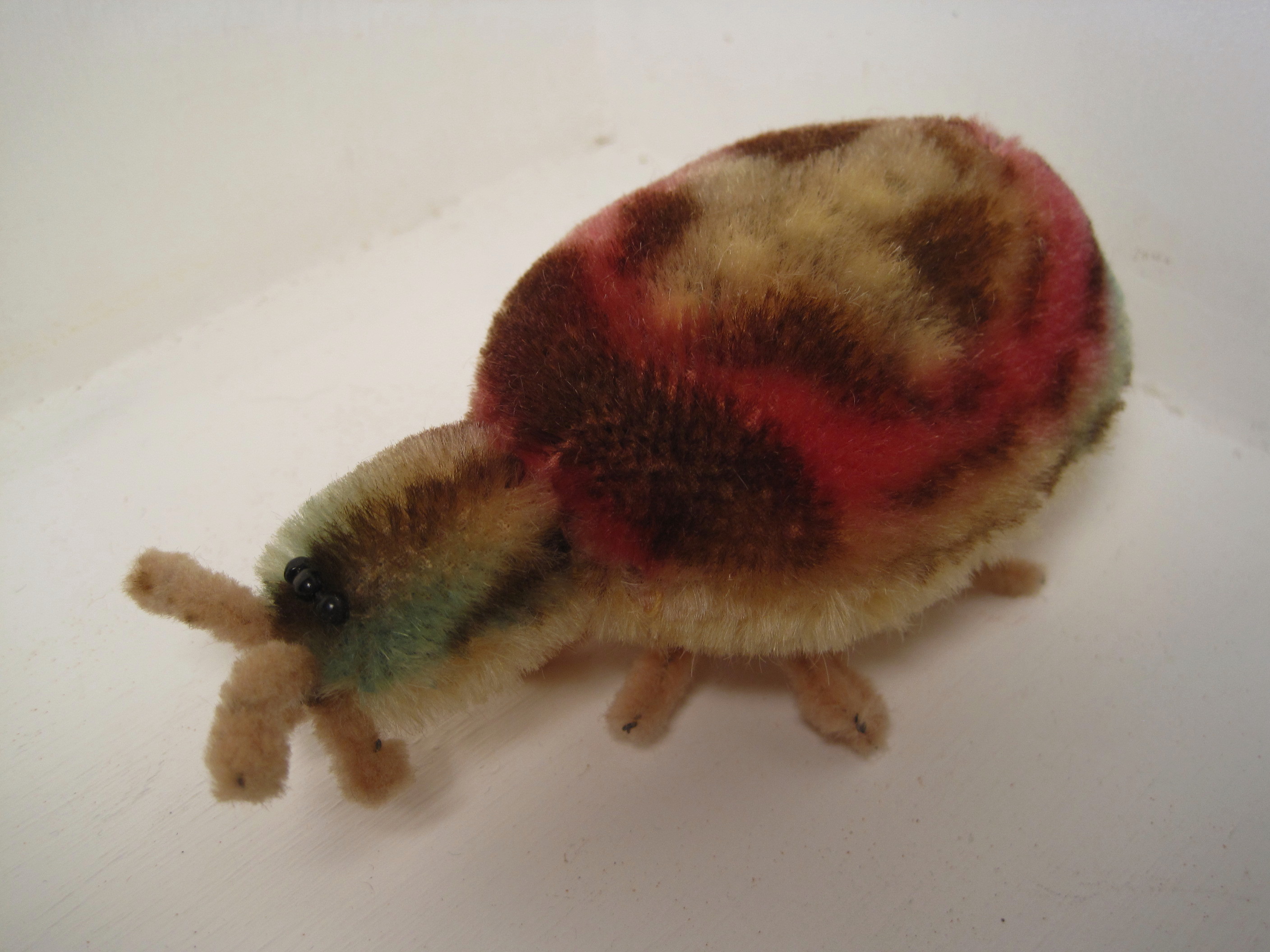
And finally, you might just get "dizzy" over this Steiff Lizzy! Here we have a simply beautiful (if that word can be applied to a lizard!) Steiff Lizzy lizard. Lizzy was produced around the same time as Steiff's "Eric" bats, "Spidy" spiders, and "Nelly" snails - clearly the "creepy crawly" era at Steiff!  She is made from yellow plush velvet which is carefully and intricately hand airbrushed with green, back, brown, and white details. She has little black eyes and thick felt feet. Her fingers and toes have remained a vibrant green color while her velvet has faded just a tiny bit. Lizzy measures about 12" from head to tail; this is the larger of the two sizes of this model, which was produced only in 1959 through 1961. Ms. Schwarz's Lizzy has her bear faced chest tag but seems to have lost her raised script button over time; this would have been located on the very tip of her tail.  Ms. Schwarz tells Steiffgal that this lovely lizard has been one of her all time favorites for about 50 years now!  Now if that's not "friends for life", Steiffgal isn't quite sure just what would be!

Steiffgal hopes this touch of vintage "retail therapy" has got you all excited for the upcoming (Steiff) holiday shopping season!  

Have a question about one of your Steiff treasures? Let's talk! Click here to learn more.
The teddy bear search engine