Tuesday, October 5, 2010

Mousing Around With Steiff's Original 1930's-era Mickey Mouse Doll

If Steiff were to have an "honorary" ambassador - besides the Teddy bear of course - many vintage fans might just vote for Mickey Mouse.  After all...

Who's the leader of the club,
That's made for you and me,
M-I-C-K-E-Y M-O-U-S-E,
Hey! there, Hi! there, Ho! there,
You're as welcome as can be,
M-I-C-K-E-Y M-O-U-S-E!
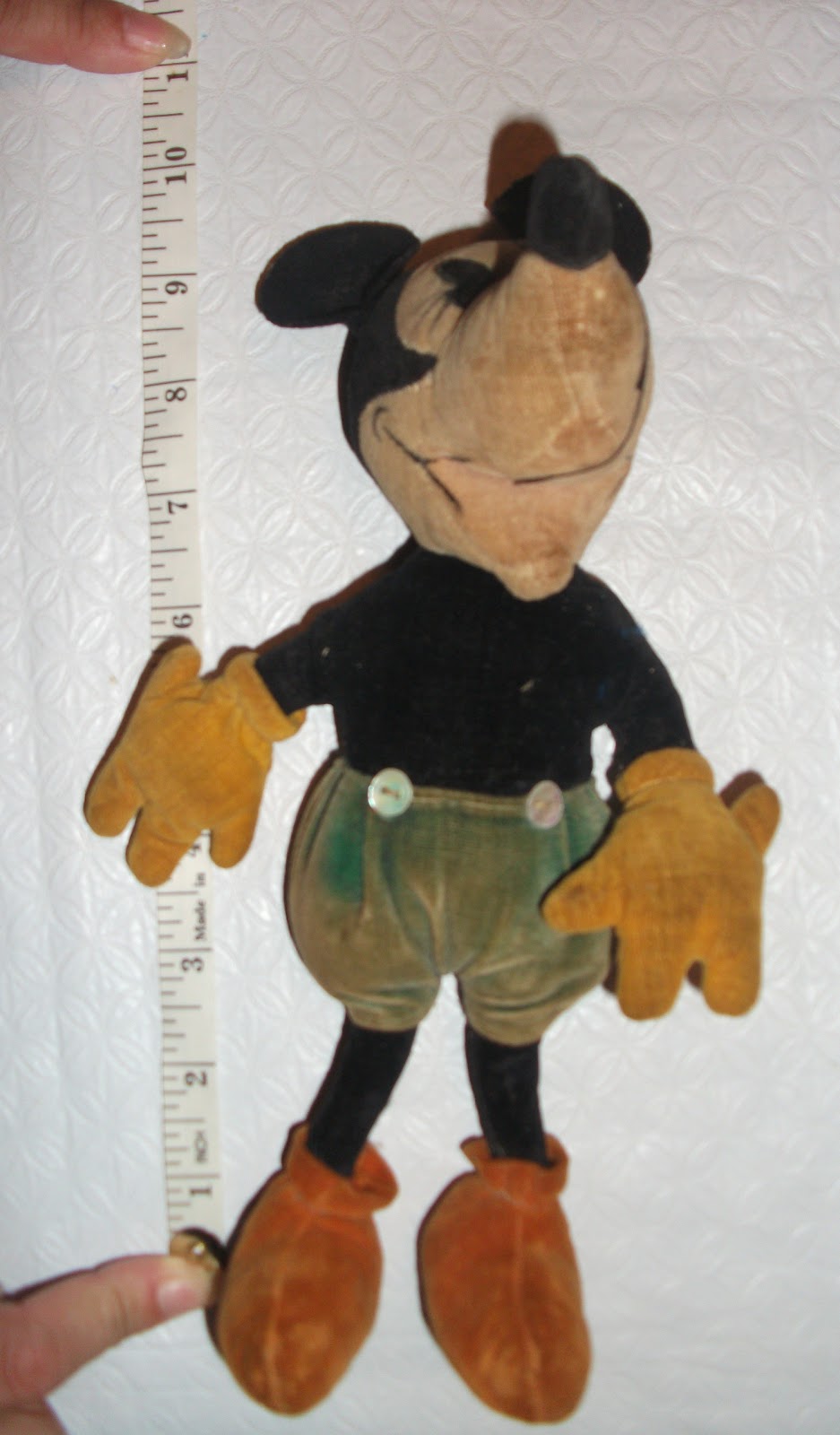
So of course Steiffgal couldn't have been more honored to receive this delightfully Disney-esque inquiry from a reader from Canada.  Doug writes:

"Hi there,

We have a Mickey Mouse that we have come across and found the picture of him on your blog. We were wondering if you could help us in regards to information about this Mickey. I have attached pictures for you to view.

Thanks, 
Doug"

Don't mean to play cat and mouse with you Doug, but this is a mighty nice find!  Although it is impossible in most cases to identify an item with 100% certainty from photographs, he does look very much like Steiff's version of Mickey from the 1930's.  Steiff's Mickey Mouse is primarily made from black and white velvet. His eyes are glued on, and he has a few black whiskers.  He wears yellow gloves and velvet pants detailed with white buttons; his trousers have appeared in a variety of colors including red and green.  Depending on his size, he has red, green, or orange shoes.   The sole of the shoes are imprinted with copyright information, as you can see ever so faintly on the picture on the left.  Steiff made Mickey Mouse from 1931 through 1936 in 11, 16, 23, 30, 36, and 48 cm. A tail moves head and a 24 cm puppet version were also produced in the same time frame. Doug's Mickey is the 23 cm version, given the photo provided.

The 1930’s marked the beginning of a long and still enduring relationship between Steiff and The Walt Disney Company.  According to the Cieslik's wonderful reference book "Button in Ear The History of the Teddy Bear and His Friends", Paul Steiff, one of Margarete's nephews, traveled to Stuttgart in order to see a Mickey Mouse movie.  On June 26, 1930 he wrote:

"We sat in the very last row and appeared to be the only ones who laughed over the film. Either no one in Germany is yet able to understand a cartoon film, or life at present is so sad that no one has the heart to laugh, or are these films unsuitable for the majority of the people?"

Nonetheless, he described Mickey as "...lively, three dimensional, comical, understanding, funny, droll, and happy" and insisted that Steiff obtain permission to manufacture and market a version of the character.  By 1931, 30,000 Steiff Mickey Mouse toys were made - truly validating Paul's product development and marketing insights!  In 1932, Steiff started working on a version of Minnie Mouse, but this proved more challenging from a design and partnership agreement. Over the six year production time frame, about 53,000 Mickey Mouse and 13,000 Minnie Mouse dolls were manufactured and distributed. These wonderful velvet dolls today are among the most precious and sought after finds for both Steiff and Disneyana collectors!

Ok, now the question that makes Steiffgal want to scamper into a mouse hole... his value.  This Mickey Mouse looks to be in ok condition.  He seems to have lost his Steiff ID, tail, and whiskers over time. It's good to see that he retains his white buttons, which are a very nice detail.  As always, something is worth what someone will pay for it.  That being said, Steiffgal roughly estimates that given his condition as presented here (and assuming solid structural integrity, no smells, rot spots, other badness, etc.) he is valued in the $250-500 range today.  A similar item in slightly better condition just sold on eBay for a little over $500 but it had its button which is a big deal to collectors.

Steiffgal hopes this discussion on Mickey Mouse has been as fun as a day in a theme park for you!

Have a question about one of your Steiff treasures? Let's talk! Click here to learn more.

Tuesday, September 28, 2010

Braying Over This Exciting Steiff Donkey Find!

C'mon, don't be stubborn like a mule here!  Take a good look at this note from a reader who asks about his recent Steiff find, a large gray donkey.  Through a series of correspondences, Brian writes...

"Hello Steiffgal, 

Recently I bought a Steiff donkey that is almost identical to the Grissy you show on your blog.  Mine is showing a little more of its age.  It seems to have straw like material on the inside.  He still has the button in the ear, but most of the yellow tag is gone, but still visible.  He has brown glass-like eyes and an open mouth.  His dimensions are 16 inches from head to butt; 13 inches from foot to head; and 9 inches from foot to back. To me he is a great find. 

Does the straw-like material on the inside make it earlier? I know very little about Steiff animals. Should I clean this donkey or will it lose its value if I do?  I know you don't do values, but I have no idea how to value this.  Your help and time would be greatly appreciated! Looking forward to hearing from you soon.   

Best,
Brian"

Brian, great job in identifying your newest Steiff farmyard friend! Yes, what you have here is what Steiff calls Grissy Esel or Grissy Donkey.  She is standing on all fours, unjointed, and made from gray dralon (an acrylic, highly durable plush-like material).  She is stuffed with excelsior, or wood-wool; this gives her the "straw" feeling and sound you describe above.

Grissy is quite detailed from head to toe.  Her muzzle is made from short dralon that has been airbrushed in black, tan, and grey to give this area more texture. She has an open, reddish-orange felt lined mouth.  Her posable ears are trimmed in stiff, straight black fur.  Grissy's hooves are constructed from brown leather-like material, while her mane and the tip of her tail are made from long black mohair.   Grissy was manufactured from 1960 through 1976 in 14, 22, 35, and 50 cm.  Given the measurements provided, it appears that Brian's Grissy is most likely the 35 cm version.

Donkeys are, and have always been, prominent in the Steiff line. They were featured in the debut Steiff catalog of 1892; these earliest models were made from felt, sported a red saddle cloth, and were available with and without wheels. Steiff has produced donkeys as puppets, pull toys, rocking animals, sleeping animals, studio animals, lulac style characters, and even as the logo of the Democratic party here in the USA! Steiffgal's favorite Steiff donkey is a sweet little 14 cm foal made from 1977 through 1985 named "Assy Esel" - really.  Just goes to show that sometimes getting "lost in translation" can be a very funny thing. (Assy is pictured here to the left adjacent to his favorite bedside reading material!) 

Cleaning is usually recommended, as it both improves the appearance as well as "shelf life" of most vintage Steiff collectibles.  In terms of cleaning excelsior stuffed dralon items, like this Grissy donkey, it is not all that different than the process behind cleaning mohair items.  Again, here's Steiffgal's recommended cleaning process:

  • First, remove as much surface dirt and dust as possible by shaking your item vigorously and then vacuuming it very gently and at a distance.
  • Second, clean your item's surface with a very weak solution of water and gentle dish detergent - just very sparingly moisten a washcloth and rub it down with the damp cloth. You'll be surprised what comes off!  Do not soak or drench the fabric here, it is truly a SURFACE cleaning.
  • Third, let the item naturally air dry away from the sun and heat sources.
  • Lastly, gently fluff up the item with a brush or comb.
Steiffgal doesn't mean to be a pain in the... ahem... backside here - but as always - something is worth what someone else will pay for it.  Factors including structural integrity, odors, rips, presence of identification, and other details can make all the difference in the world in terms of appeal, and in turn, value.  For this particular item, in the broadest terms, Steiffgal has seen Steiff Grissy donkeys sell in the $50 to $350 range, depending on their condition and their sales channel.   

According to an old Indian proverb..."To carry his load without resting, not to be bothered by heat or cold and always be content: these three things we can learn from a donkey."  Steiffgal hopes this column on Steiff donkeys has been an enjoyable teaching moment for you!   

Have a question about one of your Steiff treasures? Let's talk! Click here to learn more.

Saturday, September 25, 2010

Fall-ing for Steiff's Wonderful Squirrels

It is certainly starting to feel alot like autumn around Steiffgal's neck of the woods. There are squirrels - and acorns - all over the place. Much to her surprise, Steiffgal encountered this fearless teeny tiny baby squirrel (he really was just a handful!) on her daily walk yesterday, a sure sign that it was time to write a column about these fall loving fuzzballs!

Squirrels seem to be here, there, and everywhere - in nature as well as in Steiff's history. Squirrels have been a part of the Steiff offering since 1897; the first one to appear was begging, unjointed, and made from brown felt. A few years later, this design was updated and made in velvet. The velvet squirrels were also repurposed as pincushions; a model with a basket on her back and a model on a leaf were produced in the 1902 through 1917 time frame. Starting in 1909, Steiff began producing squirrels in mohair; only a few new models appeared through 1942. Steiff also made a 17 cm "Punch Squirrel" or squirrel hand puppet from 1937 through 1938.

 The squirrel pictured here on the left is one of these prewar models. Eichhorn, or Squirrel, is 20 cm and made from gray and white mohair. She is in an upright "begging" position and has a chubby belly and thighs. Her ears and tail - which has a metal wire in it for posing - are made from extra long mohair. She has big black eyes, a hand embroidered nose, mouth, and claws, and a carries a velvet nut. This particular model was produced from 1934 through 1942 in reddish brown and white and gray and white in 20 and 25 cm.

You won't find it nuts to learn that squirrels were one of the very first items manufactured post war when the factory reopened for business in the late 1940s. Eichhorn, described above, was brought back into the catalog from 1949 through 1956. In 1957, Steiff updated their squirrel design and named their new pattern Possy. Possy was begging, unjointed, and made from either brown and white or gray and white mohair. Like her forebearers, Possy also had extra long mohair on her wire lined tail and ear tips. Possy appeared in the line from 1957 through 1976 and was manufactured in 10, 14, and 22 cm. She was also produced as a 17 cm hand puppet from 1957 through 1961.

Steiff created another beloved squirrel pattern in the late 1950's, inspired by a Walt Disney documentary entitled True Life Adventures. This film, released in 1957, "starred" a squirrel named Perri who faced many challenges and adventures. Steiff and Disney have always had a close relationship (and still do...) so it is no surprise that Steiff produced their very own licensed version of Perri. Several 12 cm versions of Perri are featured here on the left. As you can see, Perri is made from brown tipped mohair, has a great shaggy tail, and feet and hands made out of thick felt. One of Perri's most distinctive features is his white felt backed eyes. Perry was made in 12, 17, and 22 cm from 1959 through 1983. The 17 and 22 cm versions came with a beautifully airbrushed velvet pine cone, about 2.5 cm long.

Post war, squirrels have never gone into hibernation in the Steiff line. From the 1960's through today, they have appeared as woolen miniatures, pom-pom animals, soft play animals, Christmas ornaments, and even limited editions. It is clear that these bushy tailed beauties have a special place in the hearts of many Steiff collectors.

According to Sarah Jessica Parker, “You can't be friends with a squirrel! A squirrel is just a rat with a cuter outfit.”
Steiffgal hopes this history on Steiff squirrels proves that viewpoint merits an entire wardrobe change!

Have a question about one of your Steiff treasures? Let's talk! Click here to learn more.

Saturday, September 18, 2010

This Steiff Treasure Will Make You Want To Walk In Circles!

Have you ever come across a Steiff rarity in your travels, in a book, on line, or in a store that simply took your breath away?  Well this one did just that... and literally made Steiffgal's head spin when she learned about it from a reader.  Sue from Illinois writes...

Hello Steiffgal,
 
I am an artist who was bitten by the Steiff bug a number of years ago when I began pairing a small vintage Steiff animal with my own teddy creations. 
 
I recently spotted and bought this wonderful toy from an antique mall showcase. The seller's tag didn't even identify it as "Steiff," even though upon close inspection, I found Steiff buttons embedded in the wooden pull knob and under each of the bird's wings.

Can you tell me more about this pull toy? I've never seen one like it and I'm wondering about its rarity. I would greatly appreciate any advice you could give me.  I've attached some photos.

Sincerely,
Sue"

Sue, you've really found a needle in a haystack here.  This farm-friendly rotating toy is Steiff's Roly Droly 2 Kuecken or Roly Droly 2 chicks.  It appeared in the Steiff product line from 1924 through 1934.  These are seldom available to collectors today as they were designed for hands on child's play.  Despite their inherent Steiff quality, they did tend to wear down or out over time.

Let's take a look at the components of this remarkable Roly Droly.  The chicks are 8 cm and made from yellow mohair; they are unjointed and have black eyes and felt beaks.  Their feet are metal which are wrapped tightly in yellow cord to give them a lifelike appearance.  The chicks were a standard item in the Steiff line from 1908 through 1933 and came in white and yellow over that time frame. Each chick stands on a green disk on the three wheeled wagon.  Each disk turns in a counter - clockwise direction. The wagon itself is 16 cm wide overall and has a red pull cord. The handle of the pull cord is red wood and has a Steiff button on the tip as decoration. 

Roly Drolys are fabulous examples of Steiff's early twentieth century creativity.  It is interesting to note that the name of this product is derived from the German words "rollen" (to roll) and "drollig" (funny or droll).  Overall, the Roly Droly design appeared in the Steiff line from 1924 through 1934.  In addition to the two chicks, other "spinning" animals included a bear and monkey set (came in white or brown), two bears, a chick and rabbit, and two rabbits. But Steiffgal is certain that there were other combinations too, Steiff as a company is famous for not recording everything!  Pictured here on the upper left is another example of a Steiff Roly Droly, the brown bear and monkey set.  This picture is taken from the October 13, 2010 Christie's Steiff Auction catalog.  This bear and monkey Roly Droly will be sold, with 600+  additional lots, at the much anticipated auction in London.

Just thinking about Sue's wonderful find turns Steiffgal into a "Spinning Ninny."  What about you?

Have a question about one of your Steiff collectibles? Let's talk! Click here to learn more.  Or, if you are interested in adding this treasure to your own collection, click here!
The teddy bear search engine